あたし from a middle school girl
Vocabulary Explanation: Personal Pronouns
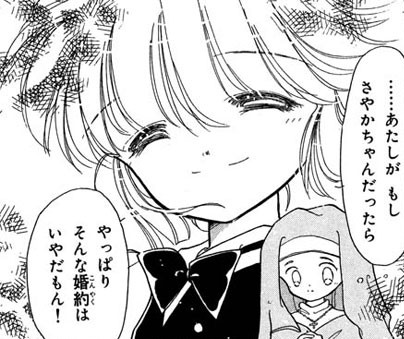
Seira learns that Sayaka’s parents have forced her into an arranged marriage engagement, even though she likes Asuka Jr. Seira relays this to Meimi, saying if Saint Tail steals the gifted wedding veil from Sayaka’s home, the engagement will be called off. Before Meimi sets out, Seira confirms her intention to go through with the theft.
- セイント・テール:
- 「あたしが もし さやかちゃんだったら やっぱり そんな婚約はいやだもん!」
- “If I were Sayaka-chan, sure enough, I'd hate such an engagement!”
Meimi often doesn’t use a personal pronoun due to context not calling for it, but when she does, she uses あたし both in narration and when with Seira. Most of Meimi’s female classmates use あたし as well.
Key Points
- あたし is a casual first-person pronoun often associated with girls and women in everyday speech.
- The が after あたし highlights Meimi as the imagined person in Sayaka’s position.
- だったら makes the condition hypothetical, so she is saying that if she were Sayaka-chan, she would feel the same.
- もん gives a casual, personal justification, like saying it is because she would hate it.
- ちゃん is an affectionate, informal suffix attached to names, used mainly for children, close friends, and family members.
Vocabulary
| Word | English | Meaning |
|---|---|---|
| あたし | I | あたし means “I” or “me”. It is a casual, feminine form of 私. |
| もし | If | もし introduces a supposition: “if” or “supposing”. |
| やっぱり | As expected | やっぱり shows that something turned out as the speaker thought, or that the speaker is coming back to an earlier choice: “after all”. |
| そんな | Like that | そんな describes something like the thing just mentioned. Said alone, it shows shock or denial: “no way!” |
| 婚約 | Engagement | 婚約 means an engagement or formal promise to marry. |
| いや | false | いや is used to deny something or to hesitate, like “no” or “well…”. It also describes something unpleasant or unwanted, often written 嫌. |
| もん | Because | もん ends a sentence to give a reason, often in a childish or pouting tone. It is a casual form of もの. |
See Also
- Vocabulary: Personal Pronouns
- Grammar: Casual reasons with 〜もん
- Grammar: Marking the topic with は and も