A big haul of basil with 大漁
Kanji Explanation: Fishing and catches with 漁
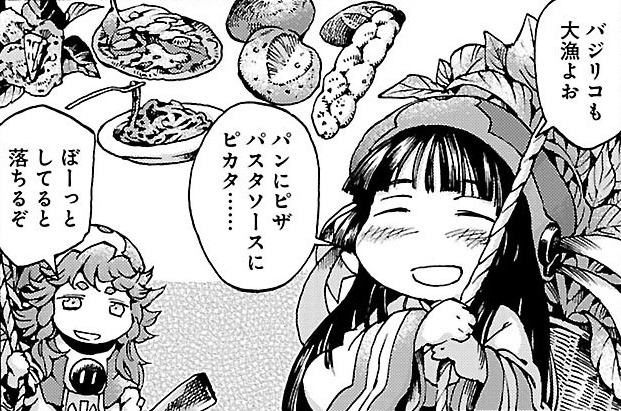
Hakumei and Mikochi are gathering wild herbs on a steep, rocky slope, climbing with ropes. When Hakumei calls over to ask how it’s going, Mikochi says she’s doing well, and the two agree that herbs from rocky hillsides have a good fragrance.
- ミコチ:
- 「バジリコも大漁よお」
- “And a big haul of basil, too!”
- 「パンにピザ パスタソースにピカタ……」
- “Bread, pizza, pasta sauce, piccata...”
- ハクメイ:
- 「ぼーっとしてると落ちるぞ」
- “If you space out, you're going to fall.”
Key Points
- 大漁 literally means a big catch of fish: 大, big, plus 漁, fishing.
- Mikochi stretches it to a different kind of haul, a large pile of basil. Speakers use 大漁 playfully like this for any plentiful harvest or find.
- 漁 is read りょう here, the same reading as in 漁師, fisherman.
- も adds basil to the herbs she has already gathered. She has done well with the others, and the basil is a big haul, too.
- The stretched よお shows how pleased she is.
- パンにピザ, パスタソースにピカタ links foods with に, like “bread and pizza, pasta sauce and piccata”. This に strings together items that go as a set.
- The trailing …… shows Mikochi drifting into daydreams about what she’ll cook.
- ぼーっとする means to space out. してる is the casual form of している.
- 〜と here states a result that follows naturally: if you space out, you fall. ぞ makes it a firm warning, which fits Hakumei’s rough speech.
Vocabulary
| Word | English | Meaning |
|---|---|---|
| バジリコ | Basil | バジリコ is basil, the herb, from the Italian word. It is common in Italian dishes such as pasta and pizza. |
| パン | Bread | パン is bread, including rolls and pastries. |
| ピザ | Pizza | ピザ is pizza, flat baked dough with toppings such as tomato sauce and cheese. |
| パスタ | Pasta | パスタ is pasta, Italian noodles such as spaghetti and penne. |
| ソース | Sauce | ソース is a sauce for food, as in パスタソース, pasta sauce. On its own it often means a thick, Worcestershire-style sauce. |
| ピカタ | Piccata | ピカタ is piccata, thin slices of meat or fish coated in flour and egg and then pan-fried. |
| ぼーっと | Absent-mindedly | ぼーっと describes being in a daze, with one’s mind elsewhere. ぼーっとする means to space out. |
| する | To do | する is to do or perform something. It also turns many nouns into verbs, as in 勉強する. |
| 落ちる | To fall | 落ちる is to drop from a higher place. It also means for a fire to die down, or to fail an exam. |
See Also
- Kanji: Fishing and catches with 漁
- Grammar: Marking the topic with は and も
- Grammar: Natural result with 〜と
- Grammar: Rough declarations with ぞ and ぜ
- Grammar: Ongoing actions and resulting states with 〜ている
- Grammar: Informing with よ