A borrowed hair clip with 髪留め
Vocabulary Explanation: Stopping, fastening, and staying over with とまる
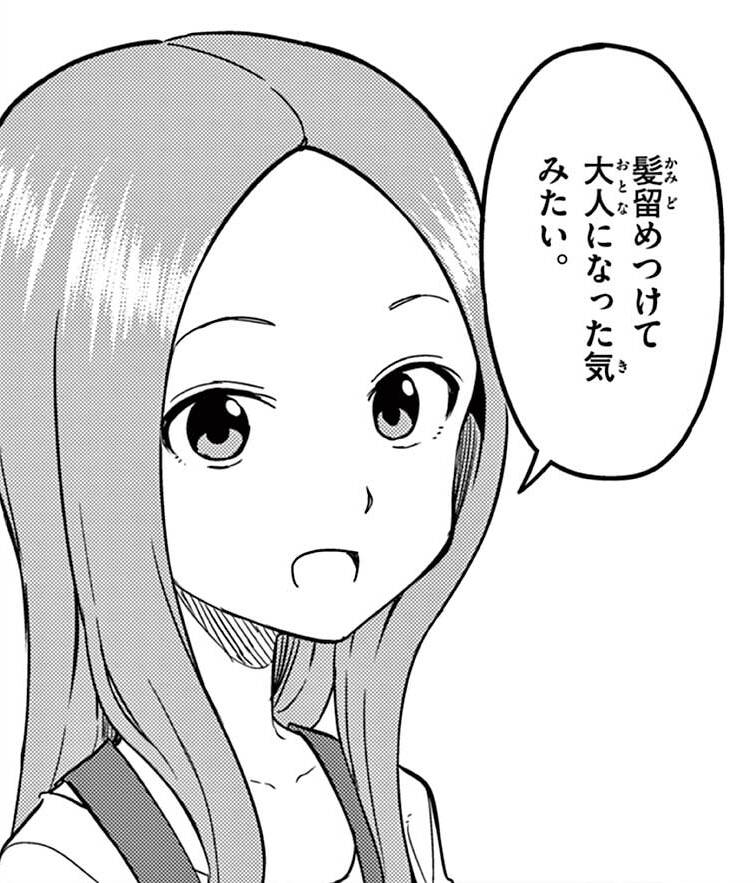
Chi shows off a clip holding up her little ponytail. When Nishikata asks about it, Takagi says she’s lending it to her. Chi asks in a ladylike voice whether it makes her look grown-up.
- 高木:
- 「髪留めつけて大人になった気みたい。」
- “Wearing the hair clip seems to make her feel all grown up.”
Key Points
- 髪留め is 髪, “hair”, plus 留め, the noun form of 留める, “fasten”. It names anything that holds hair in place, such as a clip or a barrette.
- The と of とめ turns voiced after 髪, so the word is read かみどめ, not かみとめ.
- The spelling uses 留 because the clip keeps the hair fixed in place. That’s the same 留 as ボタンを留める, “do up a button”.
- 大人になる is “become an adult”. Putting 気, “feeling”, after the past form gives 大人になった気, the feeling of having become an adult. The usual full phrase is 〜た気になる, “feel as if you’ve done something”.
- Chi hasn’t grown up, of course. The phrase says she feels that way.
- みたい at the end says “it seems”. Takagi can’t see inside Chi’s head, so she judges from Chi’s grown-up airs: 大人になった気みたい, “she seems to feel grown-up”.
- Takagi leaves out the topic, Chi, since everyone can see who she means.
- つける is the verb for putting on accessories such as clips, pins, and earrings. The て-form つけて gives the cause: wearing the clip is what makes Chi feel this way.
Vocabulary
| Word | English | Meaning |
|---|---|---|
| 髪留め | Hair clip | 髪留め is a clip, barrette, or pin that holds hair in place. |
| つける | To attach | つける is to put something on or attach it to something else, such as accessories or a name. It is also written 付ける. |
| 大人 | Adult | 大人 is a person who has grown up. It also describes someone who acts with calm and maturity. |
| なる | To become | なる is to change into a different state or become something. It also means something turns out a certain way. It is also written 成る. |
| 気 | Spirit | 気 is a person’s mind, mood, or feelings. It appears in many expressions, such as 気がする, “to have a feeling”. |
| みたい | Like | みたい follows a word to compare something to it: “like” or “similar to”. It also means “it seems”. |
See Also
- Vocabulary: Stopping, fastening, and staying over with とまる
- Grammar: Likening things with 〜みたい
- Grammar: Becoming with 〜くなる and 〜になる
- Grammar: Connecting actions with 〜て・〜で
- Kanji: People and persons with 人