A bread machine that kneads the dough with 生地をこねる
Vocabulary Explanation: Collocations for cooking
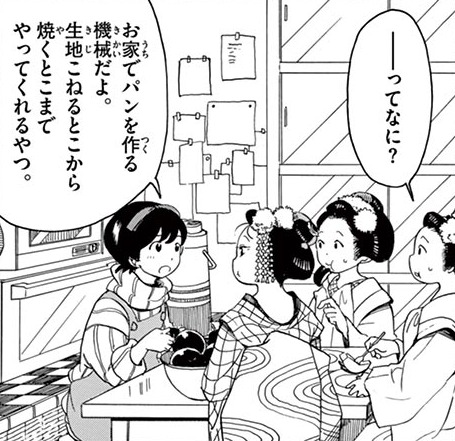
Kiyo and the maiko of the house sit around a bowl of apples in the kitchen. The talk has turned to a “home bakery”, and one of the maiko repeats the unfamiliar words.
- 舞妓さん:
- 「――ってなに?」
- “...What's that?”
- キヨ:
- 「お家でパンを作る機械だよ。生地こねるとこから焼くとこまでやってくれるやつ。」
- “It's a machine for making bread at home. It does it all for you, from kneading the dough to baking the bread.”
- Literal: “It's a machine that makes bread at home. A thing that does it for you, from the part where you knead dough to the part where you bake.”
Key Points
- 生地 is dough or batter, and こねる means to knead. Japanese pairs the two the way English pairs “knead” with “dough”.
- Kiyo drops を in casual speech: 生地こねる is 生地をこねる.
- 生地 also means fabric. Here パン and 焼く make it dough.
- とこ is the casual clipped form of ところ. After a verb it can name a stage in a process: 生地こねるとこ, “the kneading part”.
- から marks where the range starts and まで where it ends. Together they cover every step from kneading through baking.
- 〜てくれる shows that someone or something does an action that benefits the speaker’s side. The machine does the work so you don’t have to.
- やつ is a casual word for “thing” or “one”. The clause before it describes it: “the one that does it for you”.
- The manga reads 家 as うち. お家 means home, the place where you live. お家で marks where the bread gets made.
Vocabulary
なに (What)
なに asks what something is. Said alone, it shows surprise or annoyance: “what?” It is also written 何.
お家 (Home)
お家 is a soft, friendly word for home, the house where someone lives. Children use it, and adults use it when talking to them or speaking gently.
パン (Bread)
パン is bread, including rolls and pastries.
作る (To make)
作る means to create or prepare something.
機械 (Machine)
機械 is a machine, a device with moving parts that does work. It sounds the same as 機会, an opportunity.
生地 (Dough)
生地 is dough or batter, the mixture that becomes bread, pastry, or noodles once it is shaped and cooked. It also means cloth or fabric.
こねる (To knead)
こねる means to knead dough or clay, pressing and folding it with the hands until it holds together. It also appears in だだをこねる, “to throw a tantrum”.
とこ (Place)
とこ is a casual, shortened form of ところ, “place”.
焼く (To bake)
焼く is to bake, grill, or roast food. It also means to burn something.
やる (To do)
やる is a casual word for “to do”. It also means to give something to someone of lower standing, or to animals and plants.
くれる (To give)
くれる is for someone to give something to the speaker or the speaker’s side. After a て-form verb, it means someone does something for the speaker.
やつ (Guy)
やつ is a casual word for a person or thing. It can sound rough or friendly, depending on the speaker. It is also written 奴.
See Also
- Vocabulary: Collocations for cooking
- Grammar: Until an action occurs with 〜まで
- Grammar: Receiving kindness with 〜てくれる
- Grammar: How casual contractions work
- Kanji: Earth and places with 地
- Kanji: Homes and specialists with 家
- Kanji: Making and creating things with 作