A charmed fishing rod from Thailand with 釣り竿
Kanji Explanation: Fishing and baiting with 釣
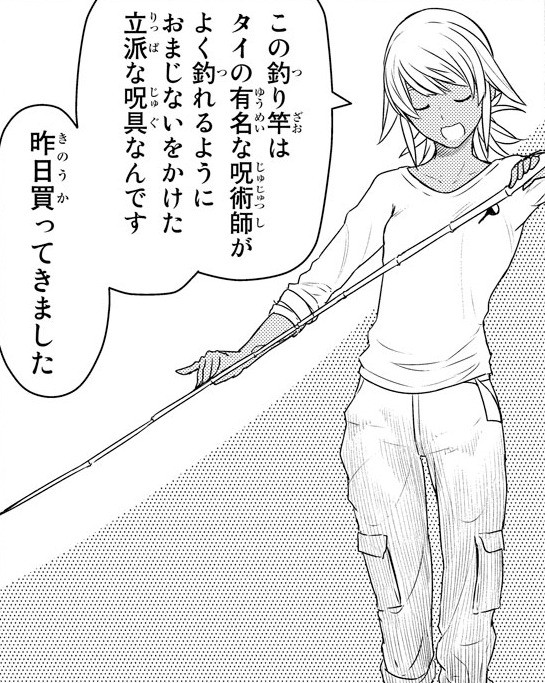
Akane drives Makoto, Kei, Chinatsu, and Nao to a river for the day. When they arrive, she shows off a bamboo rod she bought for the trip and calls it the “big-catch fishing rod”. The others think it looks cheap, and Kei asks whether it can even catch anything. Akane plays a street vendor and tells him it’s no ordinary rod.
- 茜:
- 「この釣り竿はタイの有名な呪術師がよく釣れるようにおまじないをかけた立派な呪具なんです」
- “This fishing rod is a proper magic charm. A famous sorcerer in Thailand cast a spell on it so the fish will bite.”
- 「昨日買ってきました」
- “I bought it yesterday.”
Key Points
- 釣り竿 is a fishing rod: 釣り, fishing, plus 竿, a pole. The さ of 竿 changes to ざ in the compound, so the word is read つりざお.
- On the page before, Akane named it the 爆釣釣り竿. 爆釣 is fishing slang for landing a huge haul.
- 釣れる is the intransitive partner of 釣る, to catch a fish. With 釣れる the fish “get caught”, so よく釣れる means the fish bite often. English usually says “catches a lot” or “the fish bite”.
- ように after a verb gives the purpose of an action. よく釣れるようにおまじないをかけた is “put a spell on it so that it would catch a lot”.
- Everything from タイの to かけた describes 呪具. Read the core first, この釣り竿は立派な呪具なんです, “this rod is a fine magical tool”, then add who charmed it and why.
- おまじないをかける is to put a charm or spell on something. おまじない is a small, everyday kind of magic, like a good-luck charm.
- なんです is the polite form of なのだ. Akane uses it to explain why the rod is worth the money, the way a salesperson would.
- The politeness is part of the act. A panel earlier she was talking like a rough street vendor, and now she switches to a shop clerk’s pitch.
- 買ってきました is 買う plus くる: she went out, bought it, and came back with it.
Vocabulary
| Word | English | Meaning |
|---|---|---|
| この | This | この means “this” or “these” and comes directly before a noun. It points to something near the speaker or something the speaker is referring to in the conversation. |
| 釣り竿 | Fishing rod | 釣り竿 is a fishing rod, the long pole that holds the line. |
| タイ | Thailand | タイ is Thailand, a country in Southeast Asia whose capital is Bangkok. |
| 有名 | Famous | 有名 describes someone or something known to many people. |
| 呪術師 | Sorcerer | 呪術師 is a person who works spells and curses, such as a shaman or witch doctor. |
| よく | Often | よく means something happens often. It also means “well” or “skillfully”. Before 〜ね, it can show admiration or surprise. |
| 釣れる | To be caught | 釣れる says that a fish bites and gets caught. よく釣れる describes a good place or day for fishing, and 釣れない means nothing is biting. |
| おまじない | Charm | おまじない is a small spell or ritual done for luck or protection. |
| かける | To hang | かける is to hang something up or put it over something else. It also means to spend time or money, to cause someone trouble, to make a phone call, and more. It is also written 掛ける. |
| 立派 | Splendid | 立派 means splendid, impressive, or admirable. It can praise someone’s character or describe something as imposing and well made. |
| 呪具 | Magical tool | 呪具 is an object used in magic or rituals, such as a charm or talisman. |
| 昨日 | Yesterday | 昨日 is the day before today. |
| 買う | To buy | 買う is to buy something. |
| くる | To come | くる is to move toward the speaker or the place being talked about. After a て-form verb, it shows a change coming about, or going and coming back. It is the kana spelling of 来る. |
See Also
- Kanji: Fishing and baiting with 釣
- Grammar: Doing for a reason with 〜ように
- Grammar: Reasoning with 〜のだ
- Grammar: Coming and going with 〜てくる and 〜ていく