A comet-viewing telescope with 望遠鏡
Kanji Explanation: Reflection and optics with 鏡
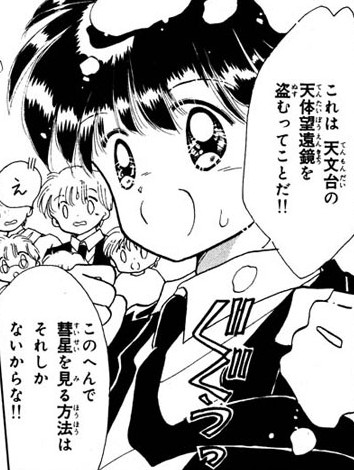
Asuka Jr. receives a challenge notice from Saint Tail, stating her intent to steal Graham Comet on Christmas Eve. One of his friends wonders how Saint Tail will steal a comet. Asuka Jr. thinks it over for a moment.
- アスカ Jr.:
- 「これは 天文台の天体望遠鏡を盗むってことだ!!」
- “That means stealing the observatory's telescope!!”
- Literal: “This means stealing the observatory's astronomical telescope!!”
- 「このへんで彗星を見る方法はそれしかないからな!!」
- “Since that's the only way to see a comet around here!!”
- Literal: “Because around here, that is the only way to see a comet!!”
Key Points
1望遠鏡 = “telescope”
- In this scene, 望遠鏡 means the observatory’s telescope, the instrument Saint Tail would have to steal in order to “steal” the comet.
- The kanji are literally “distance + see + mirror”, which fits an optical device used to view faraway objects.
2〜ってことだ = casual “that means…”
- ってことだ is a casual spoken way to say ということだ.
3このへんで = “in this area”
- このへんで sets the local context: he means that in this area, there is only one practical way to view a comet.
4それしかないからな = “because that’s the only option”
- それしかない means “there’s nothing but that” or “that’s the only option”.
- The ending からな gives his reasoning in a firm, casual, matter-of-fact tone.
Vocabulary
見る (To see)
見る means to see or look at something. It can also mean to examine its condition or nature.
方法 (Method)
方法 means a method or way of doing something.
See Also
- Kanji: Reflection and optics with 鏡
- Grammar: Marking the topic with は and も
怪盗セイント・テール © its respective creators. It is used here for educational commentary.