A discreet investigation with 極秘
Kanji Explanation: Secrecy and hiddenness with 秘 (Future entry)
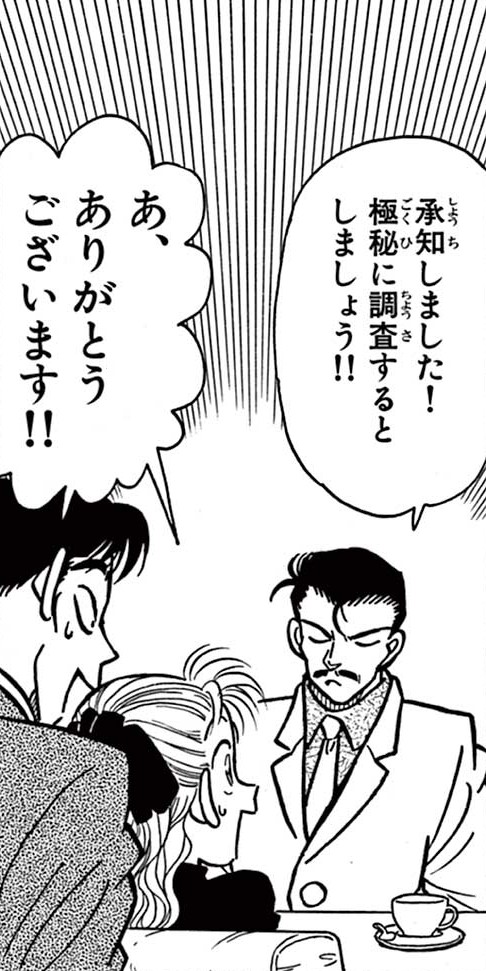
Detective Mouri’s favorite idol, Yoko, comes to his agency after receiving threatening calls and candid photos. Her manager hopes to keep the matter quiet to protect her image.
- 毛利:
- 「承知しました!極秘に調査するとしましょう!!」
- “Got it! Let's investigate this discreetly!!”
- Literal: “Understood! Let us investigate in strict secrecy!!”
- ヨーコ:
- 「あ、ありがとうございます!!」
- “Thank you very much!!”
Key Points
1極秘 = “strictly confidential”
- In this scene, 極秘に means Mouri will handle the investigation very discreetly and keep it out of public view.
- The 極- part adds intensity, so this is stronger than just saying something is merely hidden or private.
2Adverb use: 極秘に 調査する
- Here 極秘 works adverbially with に, modifying 調査する.
- The full idea is “to investigate in a highly confidential way”.
3〜するとしましょう softens the declaration a little
- Rather than a blunt 調査します, 調査するとしましょう has a slightly performative “all right, let’s proceed that way” feel.
4承知しました is formal and businesslike
- 承知しました is a polite “understood” often used when accepting a request or instruction.
- That formality matches the client-facing situation, even though Mouri’s double exclamation marks show his excitement.
Vocabulary
| Word | English | Meaning |
|---|---|---|
| 承知 | Consent | 承知 means knowledge, understanding, or consent. In conversation, it often means “understood” or “certainly”. |
| 極秘 | Top secret | 極秘 describes something kept strictly secret. |
| 調査 | Investigation | 調査 means an investigation, survey, or detailed examination of the facts. |
| とする | As | とする appears in として, “as” or “in the role of”. It also appears in 〜とする, “to assume” or “to decide on”. |
See Also
- Grammar: Past tense with 〜た・〜だ
- Grammar: Volitional with 〜う・〜よう
- Kanji: Investigation and inspection with 査
名探偵コナン © its respective creators. It is used here for educational commentary.