A dream of a catch with 大漁
Kanji Explanation: Fishing and catches with 漁
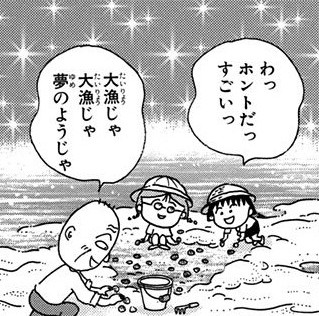
Maruko and Tamae have gone clam digging with Grandpa on a sunny Sunday, but they have found almost nothing. Then Grandpa calls them over, and when they ask if he’s found clams, he points to the spot where they’re buried.
- まる子:
- 「わっ ホントだっ すごいっ」
- “Whoa, you're right! Amazing!”
- おじいちゃん:
- 「大漁じゃ大漁じゃ 夢のようじゃ」
- “What a haul! What a haul! It's like a dream!”
Key Points
1大漁 as a big catch
- 大漁 is a large catch of fish or other seafood. 大 is big, and 漁 is the catch, so the word describes the size of the haul rather than the size of the fish.
- The word comes from fishing boats returning full, but anyone gathering seafood can use it. Here it’s clams dug from the sand, so Grandpa’s use is still literal.
- Saying 大漁じゃ twice shows how excited he is after a day of finding almost nothing.
2An old man’s じゃ
- In manga, elderly men often say じゃ where other speakers say だ. 大漁じゃ is 大漁だ, and 夢のようじゃ is 夢のようだ. Grandpa also says ここじゃよ just before this panel.
- This じゃ ends the sentence the way だ does. It’s different from the じゃ in じゃない, which is a contraction of では.
3Likening with 夢のようだ
- 〜のようだ after a noun says one thing is like another. 夢のようだ means “it’s like a dream”: the find seems too good to be real.
4Maruko’s ホントだ
- ホント is a casual spelling of 本当, true. ホントだ confirms what Grandpa said: there really are clams.
- The small っ at the end of each phrase cuts it off sharply, the way an excited shout sounds.
Vocabulary
| Word | English | Meaning |
|---|---|---|
| ホント | Really | ホント is a casual form of 本当, “truth” or “really”. |
| すごい | Amazing | すごい describes something impressive or extreme. As すごく, it intensifies other words: “really” or “very”. It is also written 凄い. |
| 夢 | Dream | 夢 is a dream, the images you see while asleep. It also means a hope for the future, and 夢のよう describes something too good to seem real. |
| よう | Way | よう follows a word to show a way or manner, or that something seems a certain way. ようになる means to reach a point where something happens. It is also written 様. |
See Also
- Kanji: Fishing and catches with 漁
- Grammar: Metaphor with 〜ようだ
- Grammar: The copula だ
- Grammar: Consonant doubling with 促音
ちびまる子ちゃん © its respective creators. It is used here for educational commentary.