A dusty book room with 〜っぽい
Grammar Explanation: Kind of like with 〜っぽい
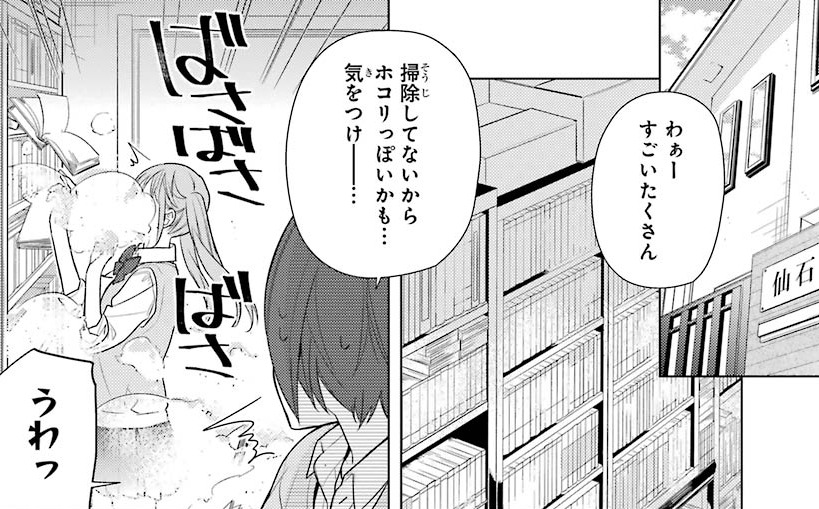
Sengoku has been lending books to his classmate Ayasaki. When he mentions that his parents’ books fill a whole room at home, she says she’d love to see it, and he invites her over.
- 綾崎:
- 「わぁー すごいたくさん」
- “Wow, there are so many!”
- 仙石:
- 「掃除してないからホコリっぽいかも… 気をつけ——…」
- “I haven't cleaned, so it might be dusty... Be care—...”
- 綾崎:
- 「うわっ」
- “Whoa!”
Key Points
- ホコリ is “dust”, written 埃 in kanji or ほこり in hiragana. Manga often writes it in katakana.
- With nouns like this, っぽい means “full of” the noun. A ホコリっぽい room has a lot of dust in it, and it’s a complaint, as っぽい often is.
- してない is していない, “haven’t done”. The い of 〜ている drops in casual speech. The room is still uncleaned.
- から marks this as the reason for what follows.
- かも is short for かもしれない, “might”. It goes straight after the い-adjective: ホコリっぽいかも, “might be dusty”.
- 気をつけ—— is 気をつけて, “be careful”, cut off. The books fall on Ayasaki before he can finish.
Vocabulary
すごい (Amazing)
すごい describes something impressive or extreme. As すごく, it intensifies other words: “really” or “very”. It is also written 凄い.
たくさん (A lot)
たくさん describes a large amount or number of something.
する (To do)
する is to do or perform something. It also turns many nouns into verbs, as in 勉強する.
ホコリっぽい (Dusty)
ホコリっぽい describes a place or thing covered in dust or full of it, such as a room nobody has cleaned. It is also written ほこりっぽい or 埃っぽい.
っぽい (-ish)
っぽい follows a word to say something seems like it or tends toward it.
かも (Might)
かも means “might” or “maybe”. It is the casual short form of かもしれない and goes at the end of a sentence to hedge a guess.
気をつける (To be careful)
気をつける is to be careful, pay attention, or watch out. 気をつけて is a common way to say “be careful” or “take care”.
See Also
- Grammar: Kind of like with 〜っぽい
- Grammar: Because with 〜から
- Grammar: Might with 〜かもしれない
- Grammar: How casual contractions work