A grater on the shelf with すり下ろす
Vocabulary Explanation: Collocations for cooking
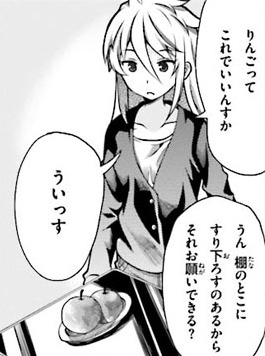
Renge is home in bed with a cold, and Kaede from the candy shop has dropped by with snacks, though she claims she only came to deliver a pillow. Renge’s older sister Kazuho heads off to make dinner and promises Renge some grated apple. Kaede offers to help, and the two go to the kitchen.
- 楓:
- 「りんごってこれでいいんすか」
- “Are these the apples you want?”
- Literal: “As for apples, is this okay?”
- 一穂:
- 「うん 棚のとこにすり下ろすのあるから それお願いできる?」
- “Yeah. There's a grater over by the shelf, so could you do that for me?”
- Literal: “Yes. Because there's a thing for grating at the shelf, can I ask you for that?”
- 楓:
- 「ういっす」
- “You got it.”
Key Points
- すり下ろす means to rub food against a grater until it turns to pulp. It joins 擦る (to rub) and 下ろす (to grate). It’s also written すりおろす or 擦り下ろす.
- The food takes を: りんごをすり下ろす, しょうがをすり下ろす. Grated apple, すりおろしりんご, is the classic food for a sick child in Japan, which is why Kazuho makes it for Renge.
- Back in the living room, Kazuho said りんごすったやつ, “grated apple”. Plain する (擦る) can mean to grate too.
- の after a verb can stand for a thing: すり下ろすの is “the thing for grating”. The proper word is おろし金, but in casual speech people often describe a tool by what it does instead of naming it.
- Kazuho also drops the が after it. Spelled out, the clause is すり下ろすのがある, “there’s a grater”.
- とこ is a casual clipping of ところ, “place”. 棚のところに means at or around the shelf, not necessarily on it.
- から gives the reason for the request that follows. The grater is right there, so Kaede can do the grating.
- お願いできる? is the potential of お願いする, “to ask a favor”: “can I ask you to do it?” それ points to the grating.
- Kazuho is Kaede’s senpai from school. いいんすか is a clipped いいんですか, “is this okay?”, with 〜んです asking about the situation.
- ういっす is a casual “yes” or “got it”. っす keeps a little respect for a senior without sounding stiff.
- りんごって marks りんご as the topic. Casual speech often uses って where formal speech would use は.
Vocabulary
りんご (Apple)
りんご is an apple. It is also written リンゴ, or 林檎 in kanji.
これ (This)
これ points to something close to the speaker, or to the thing just mentioned.
いい (Good)
いい describes something good, nice, or fine. It can also mean “okay” or “that’s enough”. Its other forms come from よい, as in よくない and よかった.
棚 (Shelf)
棚 is a shelf or rack for keeping things on, such as in a cupboard, a store, or a kitchen.
とこ (Place)
とこ is a casual, shortened form of ところ, “place”.
すり下ろす (To grate)
すり下ろす is to rub food against a grater until it turns into pulp. It is also written すりおろす.
ある (To exist)
ある is to exist or be in a place, for things and plants rather than people or animals. It also means to have something, or for an event to take place.
それ (That)
それ points to something near the listener, or to something just mentioned.
お願い (Request)
お願い is a request or favor. On its own, it also means “please”. お願いする means to ask someone for something.
できる (To be able to)
できる is to be able to do something. It also means something is finished or made. It is also written 出来る.
See Also
- Vocabulary: Collocations for cooking
- Grammar: Polite style with です and ます
- Grammar: How casual contractions work
- Grammar: Because with 〜から
- Grammar: Reasoning with 〜のだ
- Kanji: Below and lowering with 下