A half-eaten meal with 食べかけ
Vocabulary Explanation: Words ending in 掛ける
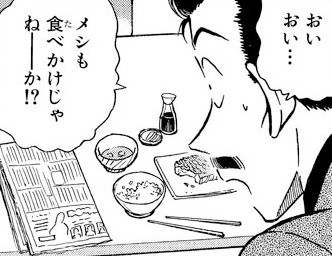
A woman has hired Kogoro to find Shibata Shiro, a man she knew thirty years ago, and they track him to his apartment. Nobody answers the bell, but Shibata’s friend Yoshikawa arrives for a mahjong game and insists Shibata must be asleep. They find the door unlocked and the TV on, so they go in.
- 小五郎:
- 「おいおい…」
- “Hey, hey...”
- 小五郎:
- 「メシも食べかけじゃね――か!?」
- “He even left his meal half-eaten!?”
Key Points
1食べかけ, half-eaten
- 食べる means to eat. Its stem plus かけ makes a noun for something left partway through, so 食べかけ means food someone started eating and didn’t finish.
- It can stand alone with だ, as here, or modify a noun with の: 食べかけのパン, a half-eaten piece of bread.
2も, “even this”
- メシも means “the meal too”. The door was unlocked and the TV was on, and now the meal has been left half-eaten as well.
3Rough speech with メシ and じゃねーか
- メシ is a rough, casual word for a meal, common in male speech.
- じゃねーか is a rough form of じゃないか. It exclaims at something the speaker has just noticed. The long ― shows Kogoro stretching it out in disbelief.
Vocabulary
メシ (Meal)
メシ is a rough, casual word for a meal or cooked rice. It is also written 飯.
食べかけ (Half-eaten)
食べかけ describes food someone started eating and didn’t finish. It can modify a noun with の, as in 食べかけのパン.
See Also
- Vocabulary: Words ending in 掛ける
- Grammar: Marking the topic with は and も
- Kanji: Eating and food with 食
名探偵コナン © its respective creators. It is used here for educational commentary.