A hard kanji championship with 選手権
Kanji Explanation: Choosing and selection with 選
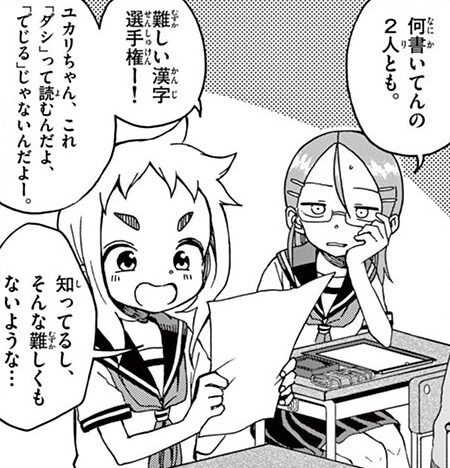
In calligraphy class, the teacher tells everyone to write a word they like and hand it in by the end of class. Yukari settles on something plain. Then Mina shouts that she’s done, and she and Sanae hold up their sheets. Mina’s reads 出汁 and Sanae’s reads 韋駄天.
- ユカリ:
- 「何書いてんの2人とも。」
- “What are you two writing?”
- ミナ:
- 「難しい漢字選手権ー!」
- “The hard kanji championship!”
- 「ユカリちゃん、これ「ダシ」って読むんだよ、「でじる」じゃないんだよー。」
- “Yukari, this is read "dashi", not "dejiru"!”
- ユカリ:
- 「知ってるし、そんな難しくもないような…」
- “I know that, and it's not even that hard...”
Key Points
- 選手権 is a championship, a contest that decides the best player or team. It adds 権, “right” or “title”, to 選手, “athlete”.
- Mina uses the grand word for a game she and Sanae made up in calligraphy class. The stretched ー at the end makes it sound like a TV announcer.
- 書いてんの is 書いているの. ている shrinks to てる, and る becomes ん before the question の.
- 2人とも means “both of you”. It comes after the question as an afterthought.
- 「ダシ」って読む quotes the reading with って. んだよ explains it to Yukari.
- 「でじる」じゃない rules out the reading you’d get from the kanji’s usual readings, 出 (で) and 汁 (しる). Mina acts as if Yukari needed the correction.
- 知ってるし means “I know”. The し hints at more reasons to come.
- そんな難しくもない means “not even that hard”. もない adds “not even”, and ような… trails off into a doubtful “it seems”.
Vocabulary
| Word | English | Meaning |
|---|---|---|
| 何 | What | 何 asks what something is. It is read なに, or なん before certain sounds. |
| 書く | To write | 書く is to write letters or words. |
| 二人 | Two people | 二人 means two people. |
| 難しい | Difficult | 難しい describes something hard to do or understand. |
| 漢字 | Kanji | 漢字 is the characters of Chinese origin used in writing Japanese, alongside hiragana and katakana. |
| 選手権 | Championship | 選手権 is a championship, a contest held to decide the best player or team. It also refers to the title the winner holds. |
| これ | This | これ points to something close to the speaker, or to the thing just mentioned. |
| 読む | To read | 読む is to read. |
| 知る | To know | 知る means to learn or come to know a fact or person. In the form 知っている, it describes already knowing. |
| そんな | Like that | そんな describes something like the thing just mentioned. Said alone, it shows shock or denial: “no way!” |
| ない | Not | ない means something does not exist or someone does not have it. After a verb, it makes the verb negative. It is also written 無い. |
See Also
- Kanji: Choosing and selection with 選
- Grammar: Ongoing actions and resulting states with 〜ている
- Grammar: How casual contractions work
- Grammar: Quoting and reporting with と and って
- Grammar: Reasoning with 〜のだ
- Kanji: Going out and emerging with 出
- Kanji: Hands and skill with 手
- Kanji: People and persons with 人