A junior or something with 〜か何か
Grammar Explanation: Or something similar with 〜か何か
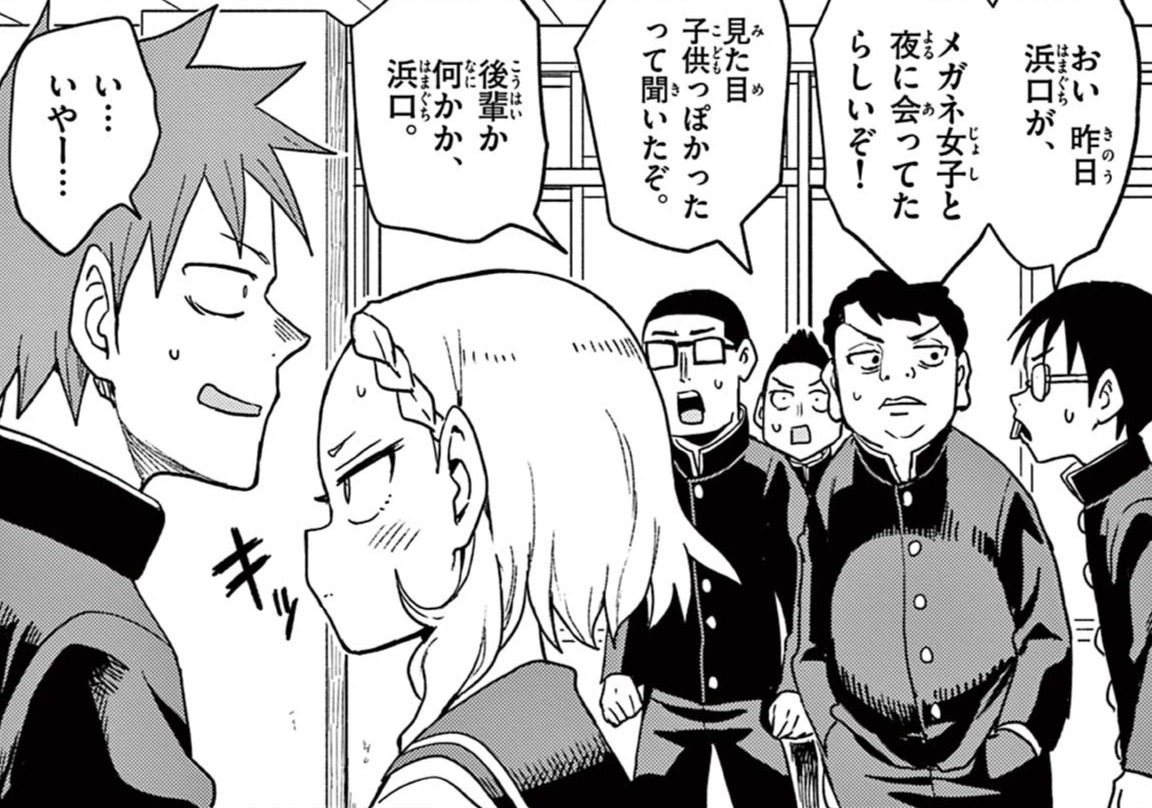
On a nighttime walk, Hamaguchi sees Hokujou casually dressed and wearing glasses. She’s fine with Hamaguchi seeing her like this, as they’ve known each other for a long time, but she tells him not to tell their classmates. At school the next morning…
- 高尾:
- 「おい 昨日浜口が、メガネ女子と夜に会ってたらしいぞ!」
- “Hey, I heard Hamaguchi was hanging out with a girl in glasses last night!”
- 生徒A:
- 「見た目子供っぽかったって聞いたぞ。」
- “I heard she looked kind of childish.”
- 生徒B:
- 「後輩か何かか、浜口。」
- “Is she a junior or something, Hamaguchi?”
- 浜口:
- 「い… いやー…」
- “Uh... well...”
Key Points
- 後輩か何か means “a junior or something”; the classmate is guessing at a category without committing to it.
- In 後輩か何かか, the first か belongs to 〜か何か, while the final か turns the whole guess into a question.
- A fuller version would be そのメガネ女子は 後輩か何かか? “Is that girl in glasses a junior or something?”
- The line does not repeat “the girl in glasses”; everyone understands that 後輩か何か is describing her.
- Naming 浜口 at the end works like calling on him to answer the rumor, not as part of the description.
- 〜か何か softens the guess, so the classmate is not asking whether she is specifically a junior and nothing else.
Vocabulary
昨日 (Yesterday)
昨日 means yesterday.
女子 (Girl)
女子 labels girls or women as a group or category.
夜 (Night)
夜 means night, the dark period between sunset and sunrise.
会う (To meet)
会う means to meet or see someone in person.
後輩 (Junior)
後輩 is a junior in the same school, workplace, or group, usually someone who joined later or has less experience.
何か (Something)
何か means something or anything. It can also introduce an uncertain question, as in “Is something wrong?”
See Also
- Grammar: Or something similar with 〜か何か
- Future entry: Past tense with 〜た・〜だ
- Kanji: After and behind with 後
- Kanji: Childhood and small things with 子
- Kanji: Women and femininity with 女