A long-desired kaleidoscope with 万華鏡
Kanji Explanation: Reflection and optics with 鏡
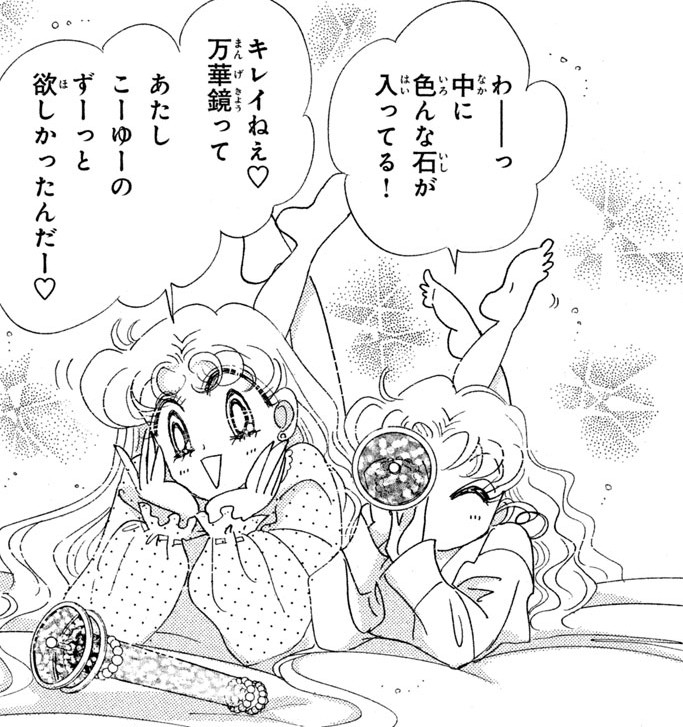
Usagi and Chibiusa look at the kaleidoscopes Mamoru bought them at the carnival.
- ちびうさ:
- 「わーーーっ 中に色んな石が入ってる」
- “Wow! There are all kinds of stones inside!”
- うさぎ:
- 「キレイねえ♡ 万華鏡って」
- “It's so pretty♡ A kaleidoscope...”
- Literal: “It's pretty, isn't it♡ A kaleidoscope...”
- 「あたし こーゆーの ずーっと 欲しかったんだー♡」
- “I've wanted one of these for so long♡”
- Literal: “I had wanted this kind of thing for a long time♡”
Key Points
- 万華鏡 is the ordinary Japanese word for a kaleidoscope, the toy tube that makes shifting colorful patterns when you look inside.
- The final kanji 鏡 means “mirror”, which fits how a kaleidoscope uses mirrors to reflect the pieces inside.
- こーゆーの is a stretched casual pronunciation of こういうの, meaning “this kind of thing”.
- ずーっと means “for a long time”, with the stretched vowel making it sound extra heartfelt and childlike.
- 欲しかった is “wanted”, and んだ adds an explanatory / emotional tone, so the line feels like “I’ve seriously wanted one of these for so long.”
Vocabulary
| Word | English | Meaning |
|---|---|---|
| 中 | Inside | 中 is the inside of something, or the middle of a situation. |
| 色んな | All sorts of | 色んな describes many different kinds. It is a casual form of 色々な. |
| 石 | Stone | 石 is a stone or rock. It also means a gem. |
| 入る | To enter | 入る is to go into a place, or for something to be inside. It also means to join a club or school. |
| キレイ | Clean | キレイ is a katakana spelling of きれい, “pretty” or “clean”. |
| 万華鏡 | Kaleidoscope | 万華鏡 means a kaleidoscope, which uses mirrors to turn colored pieces into shifting geometric patterns. |
| あたし | I | あたし means “I” or “me”. It is a casual, feminine form of 私. |
| ずっと | All along | ずっと describes something continuing the whole time, or lasting a long time. Before a comparison, it means “by far”. |
| 欲しい | Want | 欲しい describes wanting something. After a て-form verb, it means wanting someone else to do something. |
See Also
- Kanji: Reflection and optics with 鏡
- Grammar: Reasoning with 〜のだ
- Grammar: Past tense with 〜た・〜だ
- Grammar: Quoting and reporting with と and って
- Future entry: Transitivity in Japanese
- Grammar: Seeking agreement with ね
- Kanji: Entering and putting in with 入