A lunch for the night shift with 弁当を作る
Vocabulary Explanation: Collocations for cooking
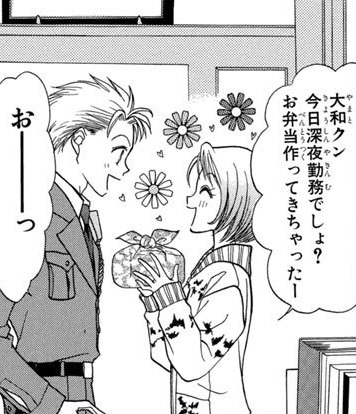
Ran has been hauled into the Shibuya police box, where her older brother Yamato works as an officer, and he has just finished lecturing her. Then Ran’s friend Miyu bursts in with a cheerful greeting.
- 美由:
- 「大和クン 今日深夜勤務でしょ? お弁当作ってきちゃったー」
- “Yamato, you're on the late-night shift today, right? I made you a lunch and brought it over!”
- Literal: “Yamato, today is late-night duty, right? I've gone and made a boxed lunch and come.”
- 大和:
- 「おーっ」
- “Ohh!”
Key Points
1お弁当を作る = to make a packed lunch
- 作る is the usual verb for making a lunch, the same verb used for making a meal or a dish. お in お弁当 is the polite prefix that this word nearly always takes.
- Miyu drops を, as casual speech often does: お弁当作って for お弁当を作って.
- Making someone a lunch is a classic way to show affection in manga, and Yamato’s delighted おーっ shows he takes it that way.
2作ってくる = make something, then come
- 〜てくる after an action means doing it somewhere else and then coming here. Miyu made the lunch before she came to the police box.
- English says “I made you a lunch” and leaves the trip implied. Japanese usually adds くる to say the food came with her.
3作ってきちゃった = 作ってきてしまった
- 〜ちゃった is the casual contraction of 〜てしまった. It attaches to きて, so きてしまった becomes きちゃった.
- Miyu made the lunch on purpose, so ちゃった doesn’t mean an accident here. It gives the announcement a playful, “I went ahead and did it” tone, and the stretched ー makes it sound even sweeter.
4でしょ? = “right?”
- With rising intonation, casual でしょ checks something the speaker already believes. Miyu knows Yamato has the late-night shift and asks him to confirm it.
- 深夜勤務 is a late-night shift: 深夜, “the middle of the night”, plus 勤務, “work duty”.
Vocabulary
今日 (Today)
今日 means today. In formal writing, it can also mean the present day or current era.
深夜 (Late night)
深夜 means late at night, usually after midnight.
勤務 (Service)
勤務 is being at work in your job. 勤務中 means on duty.
お弁当 (Boxed lunch)
お弁当 is the polite, everyday way to say 弁当, a meal packed in a box to eat away from home.
作る (To make)
作る means to create or prepare something.
くる (To come)
くる is to move toward the speaker or the place being talked about. After a て-form verb, it shows a change coming about, or going and coming back. It is the kana spelling of 来る.
See Also
- Vocabulary: Collocations for cooking
- Grammar: Coming and going with 〜てくる and 〜ていく
- Grammar: Doing completely or ending up doing with 〜てしまう and 〜ちゃう
- Grammar: Presuming with 〜だろう and 〜でしょう
- Kanji: Making and creating things with 作
- Kanji: Matching and appropriateness with 当
- Kanji: Now and the present with 今
GALS! © its respective creators. It is used here for educational commentary.