A mismatched pair with 不釣り合い
Kanji Explanation: Fishing and baiting with 釣
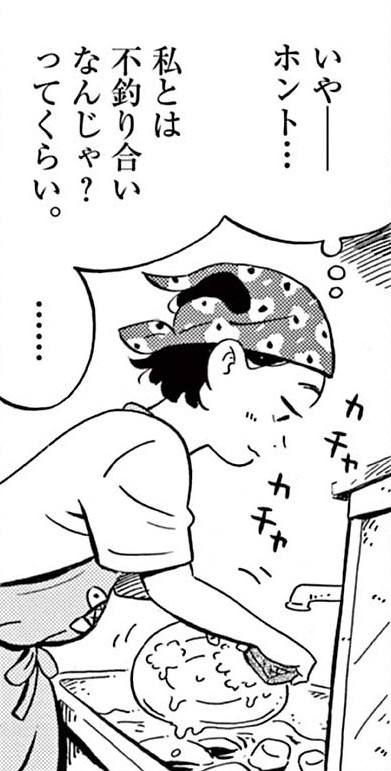
Natsumi has started a part-time job at the Chinese restaurant where her university friend Akari works. When the steam fogs Akari’s glasses and she takes them off, Natsumi realizes Akari is gorgeous, a fact she’d missed because Akari usually looks plain. Then the cook sends Natsumi off to wash dishes.
- なつみ:
- 「いや――ホント… 私とは不釣り合いなんじゃ?ってくらい。」
- “I mean, seriously... she's so pretty I have to wonder if we're kind of mismatched.”
Key Points
- 釣り合い is balance, as on a scale, and by extension a good match between two people or things. 不 negates it, so 不釣り合い means out of balance or badly matched.
- It’s a な-adjective and a noun. You’ll often hear it about couples who don’t seem to go together, which is why Natsumi stops short at her own word choice in the next panel.
- とは marks who the match is with: 私とは不釣り合い, “mismatched with me”.
- なんじゃ? is short for なんじゃない?. After a noun or な-adjective, なんじゃない? floats a guess: “isn’t it…?” or “maybe it’s…”. Natsumi cuts it off and lets the rising tone carry the question.
- って quotes the thought before it, and くらい gives the degree. 〜ってくらい means “so much that you’d think…”. Natsumi is saying how pretty Akari is by naming the thought it pushes her to.
Vocabulary
| Word | English | Meaning |
|---|---|---|
| いや | false | いや is used to deny something or to hesitate, like “no” or “well…”. It also describes something unpleasant or unwanted, often written 嫌. |
| ホント | Really | ホント is a casual form of 本当, “truth” or “really”. |
| 私 | I | 私 means “I” or “me”. It is the standard first-person pronoun in polite speech and is also common in casual speech among women. |
| 不釣り合い | Mismatched | 不釣り合い describes things or people that don’t suit each other or are out of balance, such as a couple who seem poorly matched. |
| くらい | About | くらい after a number or amount means “about” or “around”. With は, as in 一人くらいは, it means “at least”. It is also pronounced ぐらい. |
See Also
- Kanji: Fishing and baiting with 釣
- Grammar: Reasoning with 〜のだ
- Grammar: Quoting and reporting with と and って
- Kanji: Joining and fitting with 合
- Kanji: Negation and lack with 不
- Kanji: Privacy and self with 私