A picked-up earring with イヤリング
Vocabulary Explanation: イヤリング vs ピアス
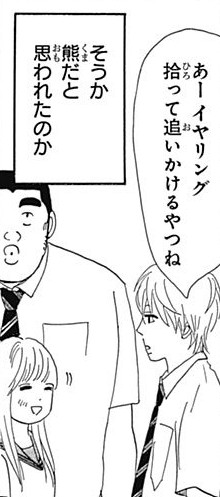
Takeo runs after a mother and her child to give them a shoe they dropped. Due to Takeo’s large size and loud steps, the mother and child get frightened and run from him. After he manages to return the dropped item, Takeo returns to his friends. Rinko remarks that the scene was like “A Bear in the Forest”. Sunakawa recalls the song.
- 砂川:
- 「あーイヤリング拾って追いかけるやつね」
- “Ah, the one who picked up an earring and chased after.”
- 猛男:
- 「そうか 熊だと思われたのか」
- “I see. It's that I was thought of as a bear?”
Key Points
1イヤリング = “clip-on earring” (no piercing needed)
- イヤリング refers to clip-on earrings that attach without piercing the ear.
- Contrast this with ピアス, which are pierced earrings (requiring an ear piercing).
- In this scene, Sunakawa is recalling the song 「森のくまさん」 (A Bear in the Forest), where a bear picks up a dropped earring.
2拾って追いかける = “pick it up and chase after [someone]”
- 拾って here is the て-form of 拾う, linking two actions together: “pick up the earring and chase after…”
- This is not a quotation って; it is just the spoken て-form inside a casual descriptive phrase.
- The subject and object are omitted because they are already understood from the song: “the one where he / the bear picks up the earring and chases after her.”
3やつね = “the one where… / the one who…” (casual shared reference)
- やつ is a casual way to say “one / guy / thing”, and here it means “the one” from the song they both know.
- [description] + やつ is a very common spoken pattern for identifying someone or something by what they do.
- ね shows confirmation or recognition: Sunakawa is basically saying, “Ah, you mean the one where he picks up the earring and runs after her.”
See Also
- Vocabulary: イヤリング vs ピアス
- Grammar: Connecting actions with 〜て・〜で
- Grammar: Receptive verbs with 〜れる
- Future entry: Past tense with 〜た・〜だ
- Grammar: Reasoning with 〜のだ
- Grammar: Quoting and reporting with と and って
俺物語!! © its respective creators. It is used here for educational commentary.