A preference for pudding with 嗜好
Kanji Explanation: Preference and indulgence with 嗜
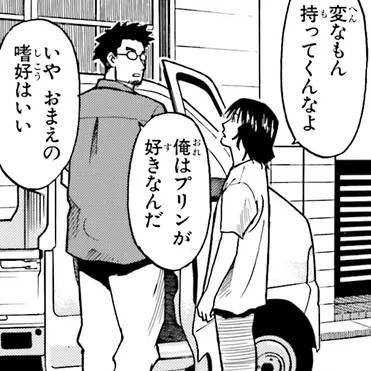
After Yousuke finishes moving his belongings into his new home with the help of his friend Jumbo, Jumbo offers to pick up some gifts for Yousuke to give his new neighbors when he goes around the neighborhood to introduce himself.
- 葉介:
- 「変なもん持ってくんなよ」
- “Don't bring back anything weird.”
- ジャンボ:
- 「俺はプリンが好きなんだ」
- “I happen to like pudding.”
- Literal: “It's just that I like pudding.”
- 葉介:
- 「いや おまえの嗜好はいい」
- “Never mind what you like.”
Key Points
- Yousuke uses おまえの嗜好 for Jumbo’s own tastes.
- もん is a casual spoken form of もの, so 変なもん means “weird stuff” or “anything weird”.
Vocabulary
| Word | English | Meaning |
|---|---|---|
| 変 | Strange | 変 describes something odd, unusual, or suspicious. |
| もん | Because | もん ends a sentence to give a reason, often in a childish or pouting tone. It is a casual form of もの. |
| 持つ | To hold | 持つ is to hold or carry something, or to have it. |
| 俺 | I | 俺 means “I” or “me”. Men commonly use it in casual speech, and it sounds rougher and more masculine than 私 or 僕. |
| プリン | Pudding | プリン is custard pudding with caramel sauce, a popular Japanese dessert. |
| 好き | Liked | 好き describes something you like or someone you love. |
| いや | false | いや is used to deny something or to hesitate, like “no” or “well…”. It also describes something unpleasant or unwanted, often written 嫌. |
| おまえ | You | おまえ is a casual, rough word for “you”. Men often use it toward people of equal or lower standing. It is also written お前. |
| 嗜好 | Taste | 嗜好 means a taste or preference, especially in food, drink, or hobbies. |
| いい | Good | いい describes something good, nice, or fine. It can also mean “okay” or “that’s enough”. Its other forms come from よい, as in よくない and よかった. |
See Also
- Kanji: Preference and indulgence with 嗜
- Grammar: Reasoning with 〜のだ
- Grammar: The copula だ
- Grammar: Marking the topic with は and も
- Grammar: The prohibitive な
- Grammar: Consonant doubling with 促音
- Grammar: Informing with よ
- Grammar: How casual contractions work
- Grammar: Coming and going with 〜てくる and 〜ていく