A pretty clean room with 相当
Kanji Explanation: Mutuality and appearance with 相
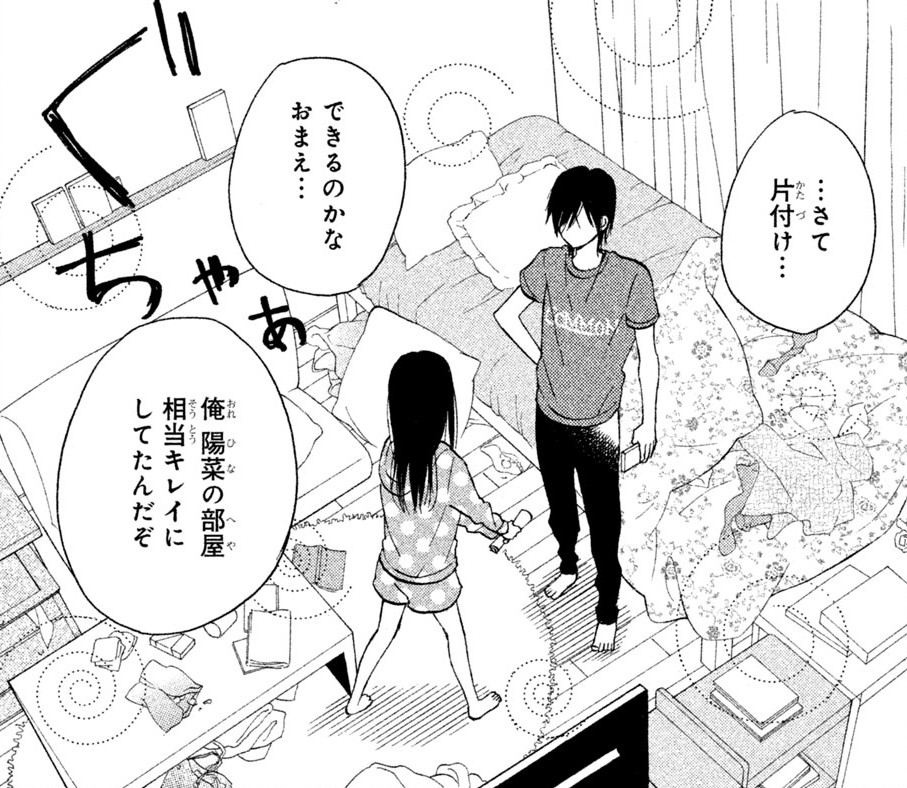
Hiro lets Mao move into his sister’s bedroom, as Hina is living with relatives. After, he comes up with a list of rules that Mao needs to follow if she’s to keep living there.
- 基:
- 「…さて 片付け…」
- “Now then, cleaning...”
- 「できるのかな おまえ…」
- “I wonder if you can do it.”
- 「俺 陽菜の部屋相当キレイにしてたんだぞ」
- “I kept Hina's room pretty clean, you know.”
- Literal: “I had made Hina's room considerably clean, you know.”
Key Points
1相当 = “quite” as an adverb
- Here 相当 modifies キレイにしてた, so it means Hiro kept the room quite clean.
- It is not “appropriate” or “equivalent” here; the scene is about degree.
2Casual sentence shape: 部屋(を)相当キレイにしてた
- The object marker を is omitted in casual speech.
- That means “I kept Hina’s room pretty clean”, not “Hina’s room became clean”.
3〜てた = casual 〜ていた
- してた is the spoken contraction of していた.
- It presents this as an ongoing state in the past: Hiro was keeping the room clean over time.
4んだぞ adds insistence
- んだ gives an explanatory or assertive tone, and ぞ makes it sound rough and emphatic.
- In context, Hiro is stressing his own track record to question whether Mao can manage the room.
Vocabulary
俺 (I)
俺 means “I” or “me”. Men commonly use it in casual speech, and it sounds rougher and more masculine than 私 or 僕.
部屋 (Room)
部屋 means a room separated from other spaces in a building.
相当 (Corresponding)
相当 means suitable or equivalent to a standard. As an adverb, it means considerably or quite.
See Also
- Kanji: Mutuality and appearance with 相
- Future entry: Past tense with 〜た・〜だ
- Grammar: Reasoning with 〜のだ
- Kanji: Sections and departments with 部
- Kanji: Shelter and shops with 屋
たいようのいえ © its respective creators. It is used here for educational commentary.