A rare chance to cook for a star with 手料理を振る舞う
Vocabulary Explanation: Collocations for cooking
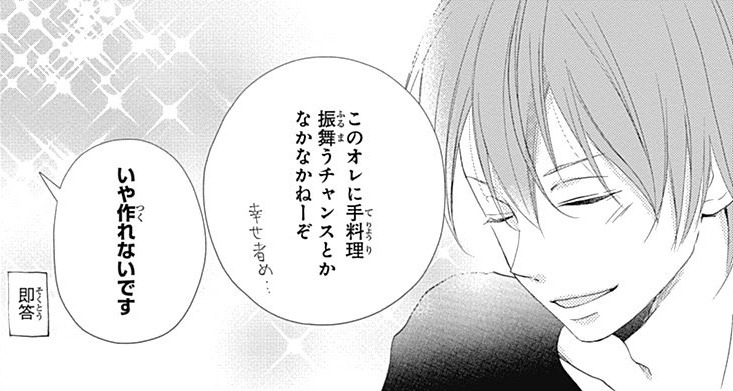
Ayato Kousaka, an actor with a fever, stops at the shop Yusa’s family runs, and her mother lets him rest at their house. Yusa says he should probably eat something before taking his medicine, and Ayato tells her to make him rice porridge or something.
- 絢人:
- 「このオレに手料理振舞うチャンスとかなかなかねーぞ。」
- “You don't often get a chance to treat someone like me to your home cooking.”
- Literal: “A chance to serve home cooking to this me isn't easily had.”
- 「幸せ者め…」
- “Lucky girl…”
- 結沙:
- 「いや作れないです。」
- “Um, no. I can't cook.”
- ー:
- 「即答」
- “Instant Answer”
Key Points
- 手料理 is food someone cooks with their own hands, usually at home. 振舞う means to serve food or drink to guests as a treat.
- The person who gets the meal takes に: 人に手料理を振舞う. Ayato drops the を, as people often do in casual speech.
- Both 振舞う and 振る舞う are standard spellings.
- Putting この in front of a first-person pronoun stresses who the speaker is. Ayato is a famous actor, and このオレに shows how highly he thinks of himself.
- なかなか with a negative means something doesn’t happen easily. ねー is a rough, casual way to say ない, so なかなかねーぞ means “you won’t find that often.”
- とか softens チャンス into “a chance like this,” and ぞ makes the line a confident announcement.
- 幸せ者 is a lucky person. The suffix め shows contempt, but here it’s teasing, much like “you lucky dog.”
- 作れない is the negative potential form of 作る. Yusa’s いや turns down his whole premise, and the caption 即答, “instant answer,” stresses that she didn’t hesitate.
Vocabulary
この (This)
この means “this” or “these” and comes directly before a noun. It points to something near the speaker or something the speaker is referring to in the conversation.
オレ (I)
オレ is a katakana spelling of おれ, a casual, masculine word for “I”. It is also written 俺.
振舞う (To treat someone to)
振舞う means to serve food or drink to someone as a treat, as in 手料理を振舞う. It also means to behave or act a certain way. It’s also written 振る舞う.
チャンス (Chance)
チャンス is an opportunity or good chance to do something.
なかなか (Quite)
なかなか means “quite” or “pretty”. With a negative, it means something does not happen easily.
いや (false)
いや is used to deny something or to hesitate, like “no” or “well…”. It also describes something unpleasant or unwanted, often written 嫌.
作る (To make)
作る means to create or prepare something.
即答 (Immediate answer)
即答 is answering on the spot, without stopping to think.
See Also
- Vocabulary: Collocations for cooking
- Grammar: Able to do with 〜れる・〜られる
- Kanji: Hands and skill with 手
- Kanji: Making and creating things with 作