A run-down fishing village with 漁村
Kanji Explanation: Fishing and catches with 漁
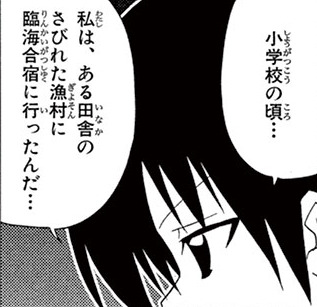
Hayate tried to slip away on an errand, but the Video Research Club girls stopped him. Their clubroom is gone, so they are starting over with new videos, and the first project is an “Ordinary Story Contest”. When Nagi asks what that is supposed to be, Risa says she’ll show them and starts telling a story.
- 理沙:
- 「小学校の頃…」
- “Back in elementary school...”
- 理沙:
- 「私は、ある田舎のさびれた漁村に臨海合宿に行ったんだ…」
- “I went to a seaside camp in a run-down fishing village out in the countryside...”
Key Points
- Here 漁村 means a fishing village, a coastal community whose people live by fishing.
- 漁 is fishing, and 村 is village. In this compound 漁 is read ぎょ, as in 漁港, and 村 takes its on reading そん.
- In the next panel Risa calls the same place a 村. On its own, 村 is read むら.
- さびれる, also written 寂れる, means a place has lost its people and activity. Shops close, the young leave, and the streets go quiet.
- The past form さびれた before a noun describes the result. さびれた漁村 is a village that has already become run-down, not one in the process of declining.
- 漁村に marks the destination, where Risa went.
- 臨海合宿に行く marks what she went there for. An event or activity noun with に行く means going to take part in it, like 買い物に行く.
- 臨海 means by the sea, and 合宿 is a group stay for training or study. A 臨海合宿 is a school’s summer camp at the seaside.
- ある before a noun means “a certain”. ある田舎 is “a certain countryside place”, a spot the storyteller doesn’t name.
- Risa ends with 行ったんだ, the past tense plus んだ. The んだ gives her listeners the background they need for the story, the way “So, I once went to…” does in English.
Vocabulary
| Word | English | Meaning |
|---|---|---|
| 小学校 | Elementary school | 小学校 is elementary school, the first six years of school in Japan. |
| 頃 | Time, days | 頃 is a period or point in time, as in 子どもの頃, “when I was a child”. After a time expression it is read ごろ and means “around”, as in 三時頃. |
| 私 | I | 私 means “I” or “me”. It is the standard first-person pronoun in polite speech and is also common in casual speech among women. |
| ある | To exist | ある is to exist or be in a place, for things and plants rather than people or animals. It also means to have something, or for an event to take place. |
| 田舎 | Countryside | 田舎 is the countryside, away from cities. It also means one’s hometown in the country. |
| さびれる | To become run-down | さびれる, also written 寂れる, is for a place to lose its people and activity and fall into decline, like a town whose shops have closed. |
| 漁村 | Fishing village | 漁村 is a village on the coast whose people live by fishing. |
| 臨海 | Seaside | 臨海 describes something located by the sea or facing it, as in a seaside school camp or a coastal industrial zone. |
| 合宿 | Training camp | 合宿 is a group staying together for several days to train or study, as school clubs do in the holidays. |
| 行く | To go | 行く means to go or move toward a place away from the speaker. |
See Also
- Kanji: Fishing and catches with 漁
- Grammar: Going to for a purpose with 〜に行く
- Grammar: Reasoning with 〜のだ
- Grammar: Past tense with 〜た・〜だ
- Grammar: Marking the topic with は and も
- Kanji: Going and carrying out with 行
- Kanji: Joining and fitting with 合
- Kanji: Learning and schooling with 学
- Kanji: Privacy and self with 私
- Kanji: Schools and checking with 校