A schoolyard chicken coop with 小屋
Kanji Explanation: Shelter and shops with 屋
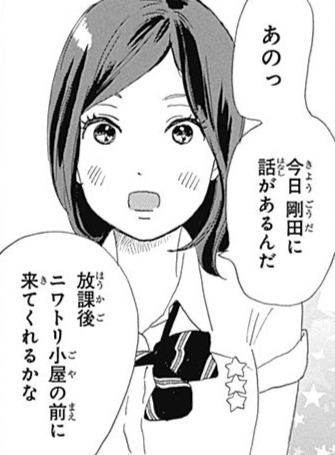
After Takeo (Gouda) has helped her out multiple times, Saijou considers confessing her feelings to him. She waits for him near the shoe lockers before class.
- 西城:
- 「あのっ 今日剛田に話があるんだ」
- “Um... I need to talk to you today.”
- 「放課後ニワトリ小屋の前に来てくれるかな」
- “Could you come to the chicken coop after school?”
- Literal: “I wonder if you could come in front of the chicken coop after school.”
Key Points
- In this scene, 小屋 refers to a small structure on school grounds rather than a full-sized building.
- When 小屋 follows another noun, it is often read ごや in compounds, so ニワトリ小屋 means “chicken coop”.
- This is more specific than translating 小屋 by itself as just “hut” or “shed”.
- 〜てくれるかな literally has an “I wonder if you’d…” feeling, so it sounds gentler and more nervous than a direct command.
- 話がある means “I have something to talk about”, often suggesting a meaningful or serious topic.
- The んだ adds explanatory or emotional weight, which helps set up why she asks him to come to a specific place later.
Vocabulary
| Word | English | Meaning |
|---|---|---|
| あの | That | あの comes before a noun to mean “that” or “those”. It points to someone or something away from both speakers, or something they both know about. |
| 今日 | Today | 今日 means today. In formal writing, it can also mean the present day or current era. |
| 話 | Talk | 話 is a talk or conversation. It also means a story, or what someone said. |
| ある | To exist | ある is to exist or be in a place, for things and plants rather than people or animals. It also means to have something, or for an event to take place. |
| 放課後 | After school | 放課後 is the time after classes end for the day. |
| ニワトリ | Chicken | ニワトリ is a chicken, the farm bird. It is also written 鶏. |
| 小屋 | Hut | 小屋 means a small, simple building such as a hut, shed, or animal shelter. |
| 前 | Front | 前 is the front of something. It also means an earlier time, as in 三年前, “three years ago”. |
| 来る | To come | 来る means to come or move toward the speaker or the place being discussed. |
See Also
- Kanji: Shelter and shops with 屋
- Grammar: Receiving kindness with 〜てくれる
- Grammar: Wondering with かな
- Grammar: Reasoning with 〜のだ
- Grammar: The copula だ
- Grammar: Compound voicing with 連濁
- Future entry: Transitivity in Japanese
- Kanji: After and behind with 後
- Kanji: Now and the present with 今
- Kanji: Releasing and sending out with 放