A shattered pot returns to the earth with 還る
Vocabulary Explanation: Going home and giving back with かえる
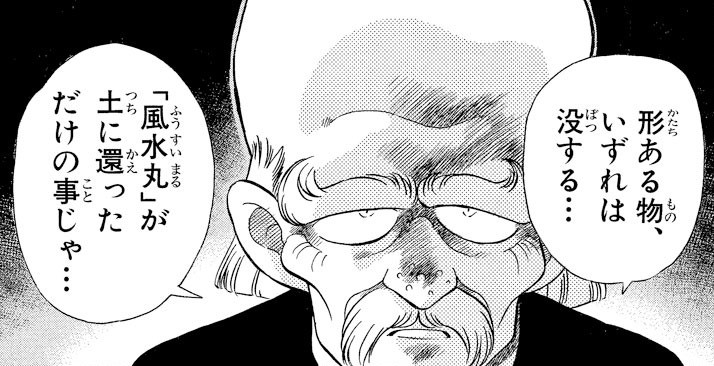
The famous potter Kikuemon has invited Kogoro to his home and sent his daughter-in-law, Masuko, to bring his new work, Fusuimaru, from the storehouse to show him. A cry from the storehouse brings everyone running, and they find the piece smashed on the floor. Masuko starts to apologize, saying it rolled down on her just as she started up the ladder, but Kikuemon cuts her off with “Enough!”
- 菊右衛門:
- 「形ある物、いずれは没する…」
- “Everything that has form perishes sooner or later...”
- 「『風水丸』が土に還っただけの事じゃ…」
- “Fusuimaru has just gone back to the earth, that's all...”
Key Points
- 還る is an unofficial spelling of 帰る. The 常用漢字表 gives 還 only its on reading カン, as in 生還, “coming back alive”, so standard writing would have 土に帰る.
- Manga use 還る for going back to where everything began. Usually it’s a body going back to the soil after death. Kikuemon applies it to a broken pot. The clay came out of the ground, and now it’s headed back there.
- Calling the loss a return to the earth lets him accept it calmly. 〜だけの事じゃ adds “that’s all it is”, so the sentence makes a new masterpiece sound like nothing worth fussing over.
- 形ある物 is “things that have form”. 形ある is 形がある with the が left out, an older, literary way to say “having form”.
- 没する is a formal verb for sinking out of sight, like the sun setting, and by extension for dying or disappearing. Here it means “perish”.
- いずれは is “sooner or later”, and the は stresses that the day will come, however far off. 形ある物 has no particle after it, just a comma, which suits a solemn general statement.
- だけ limits the statement to “just” this, and 事 turns the clause into a noun: “it’s just a matter of Fusuimaru having returned to the earth”.
- じゃ in place of だ is a copula manga give to old men, and Kikuemon uses it throughout the chapter.
Vocabulary
| Word | English | Meaning |
|---|---|---|
| 形 | Form | 形 is the shape or form of something. In polite speech, 〜という形 means “in the form of” or “set up as”. |
| ある | To exist | ある is to exist or be in a place, for things and plants rather than people or animals. It also means to have something, or for an event to take place. |
| 物 | Thing | 物 is a physical thing or object. |
| いずれ | Sooner or later | いずれ points to a time that will come eventually, even if nobody knows when, as in いずれわかる, “you’ll find out one day”. It can also mean “which” or “either” among a few choices, a formal use. |
| 没する | To sink, to pass away | 没する is a formal verb for sinking or setting out of sight, like the sun going down. It also means to die or to vanish. |
| 土 | Earth, soil | 土 is the earth or soil of the ground, the dirt plants grow in. Pottery clay is 土 too. |
| 還る | To return (to the source) | 還る is an unofficial spelling of 帰る, “go back”. Manga use it for going back to where something began, as in 土に還る, “return to the earth”. |
| だけ | Only | だけ limits something to what it follows and excludes anything else: これだけ, “just this”. |
| 事 | Thing | 事 is an abstract thing, matter, or fact. It also turns a verb phrase into a noun, as in 見た事がある. It is often written こと. |
See Also
- Vocabulary: Going home and giving back with かえる
- Grammar: Limiting with 〜だけ
- Kanji: Matters and events with 事
- Kanji: Sinking and disappearing with 没
- Kanji: Things and kinds with 物