A sign of summer with 風物詩
Kanji Explanation: Poetry and verse with 詩 (Future entry)
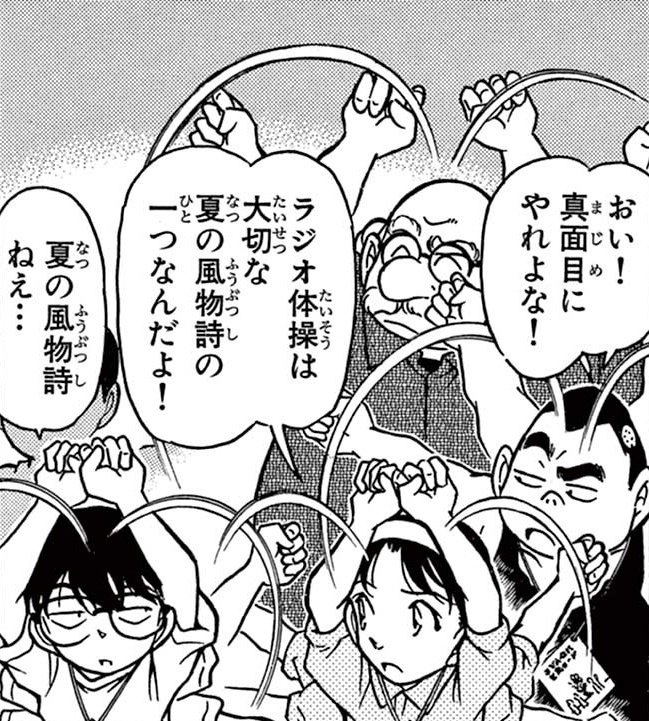
Conan has joined the other children for radio exercises at school. As everyone follows the routine, he broods over how he should be enjoying his summer vacation as a second-year high school student. Instead, he is stuck exercising with elementary schoolers and wonders what he is doing there.
- 元太:
- 「おい! 真面目にやれよな!」
- “Hey! Take this seriously!”
- 歩美:
- 「ラジオ体操は大切な夏の風物詩の一つなんだよ!」
- “Radio exercises are one of those treasured signs of summer!”
- コナン:
- 「夏の風物詩ねえ…」
- “A sign of summer, huh...”
Key Points
- Here 風物詩 means a sight, activity, or custom that brings a season to mind. Ayumi uses it for radio exercises.
- The 詩 in the word means poetry, but the whole compound here refers to something evocative of a season. Translating it as “poem” would miss what Ayumi means.
- The first の connects summer with its characteristic sights and customs. The second の selects one of those things.
- Ayumi is saying radio exercises are one of summer’s familiar customs, not its only one.
- やれ is the imperative of やる, “to do”. 真面目にやれ tells Conan to put some effort into the exercises.
- Conan repeats 夏の風物詩 with a drawn-out ねえ. His expression makes “A sign of summer, huh…” a better fit than an enthusiastic agreement.
- Ayumi presents the exercises’ place in summer as a reason to take them seriously. んだ is the casual form of のだ, and よ directs the explanation at Conan.
- The noun 一つ takes な before んだ, giving 一つなんだよ.
Vocabulary
真面目 (Serious)
真面目 describes someone who acts honestly and puts real effort into things instead of joking around or cutting corners. 真面目にやる means to do something properly and with effort.
やる (To do)
やる is a casual word for “to do”. It also means to give something to someone of lower standing, or to animals and plants.
ラジオ (Radio)
ラジオ is a device that picks up broadcast sound programs, such as news and music. It also means that kind of broadcasting.
ラジオ体操 (Radio exercises)
ラジオ体操 is a short routine of light exercises done in time with music and instructions broadcast on the radio. In Japan, people do it together at schools, parks, and workplaces, and children often gather for morning sessions during summer vacation.
夏 (Summer)
夏 is the hottest season of the year, coming after spring and before autumn. In Japan, it usually means June through August.
一つ (One)
一つ is the number one when counting things that have no special counter word. 〜の一つ means “one of” a group, as in 好きな歌の一つ, “one of my favorite songs”. It is also written ひとつ.
See Also
- Grammar: The plain imperative
- Grammar: Reasoning with 〜のだ
- Grammar: Informing with よ
- Grammar: Seeking agreement with ね
- Grammar: Marking the topic with は and も
- Kanji: Body and substance with 体
- Kanji: Faces and surfaces with 面
- Kanji: Things and kinds with 物