A slip of the tongue with 滑らせてしまった
Grammar Explanation: Making and letting with 〜せる・〜させる
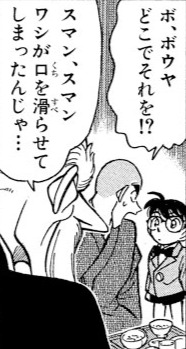
A flat tire and rain send Kogoro, Ran, and Conan to a nearby temple. The priest invites them to stay overnight, but warns them about the Mist Tengu. That night, they dine along with the monks training there. Conan takes an opportunity to ask about the Mist Tengu, catching the monks off guard.
- 寛念:
- 「ボ、ボウヤどこでそれを!?」
- “K-kid, where did you hear that!?”
- 天永:
- 「スマン、スマン ワシが口を滑らせてしまったんじゃ…」
- “Sorry, sorry. I let it slip...”
Key Points
1口を滑らせる means to let something slip
- Tenei admits that he said something he should have kept to himself. The expression describes an accidental disclosure.
- 滑る means to slip, and its causative form is 滑らせる. With 口を, the image is letting one’s tongue slip. Ten’ei is talking about his own speech.
2〜てしまった adds regret about what happened
- 滑らせて is the て-form of 滑らせる, followed by しまった. Here, the past form and the apology present the disclosure as an unfortunate mistake that has already happened.
3んじゃ explains why Conan knows
- Here, んじゃ corresponds to んだ, the casual form of のだ. Ten’ei supplies the explanation for Conan’s knowledge.
- じゃ in place of だ and ワシ for “I” give Ten’ei an elderly man’s voice. スマン is a casual apology corresponding to すまない.
4どこでそれを!? leaves the verb unsaid
- Kannen’s question can be filled out as どこでそれを聞いた, “Where did you hear that?” それ refers to what Conan has just brought up.
- ボ、ボウヤ is a startled, stammered address to Conan. ボウヤ means “little boy” or “kid”.
See Also
- Grammar: Making and letting with 〜せる・〜させる
- Grammar: Doing completely or ending up doing with 〜てしまう and 〜ちゃう
- Grammar: Reasoning with 〜のだ
名探偵コナン © its respective creators. It is used here for educational commentary.