A son who just turned five with 〜たばかり
Grammar Explanation: Just happened with 〜た+ばかり
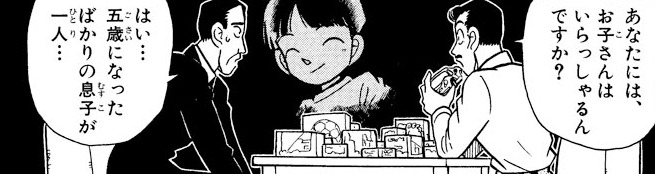
A man in a suit comes to the Mouri Detective Agency carrying an armful of toys. He explains that for about two years, toys have arrived every month along with money, and the sender’s name and address are fake. Kogoro looks over one of the toys, puzzling over why anyone would send both.
- 小五郎:
- 「あなたには、お子さんはいらっしゃるんですか?」
- “Do you have any children?”
- 小川:
- 「はい…五歳になったばかりの息子が一人…」
- “Yes... a son who just turned five...”
- Literal: “Yes... one son who has just become five years old...”
Key Points
- The た-form なった plus ばかり says the event happened not long ago. Here the event is the son’s fifth birthday.
- ばかりの lets the whole phrase 五歳になったばかり describe the noun after it: the son is identified by what just happened to him.
- 〜になる means “to become”. With an age, it means turning that age: 五歳になった, “turned five”.
- The man stops before the verb. In full it would be 息子が一人います, “I have one son”.
- The number 一人 comes after 息子が, a common way to give a count in Japanese.
- いらっしゃる is the respectful verb for いる. Kogoro uses it for the client’s children, along with the polite お子さん.
- あなたには makes the client the topic. The subject of いらっしゃる is お子さん, so the pattern is XにはYがいる, “X has Y”. In a yes-or-no question like this one, Y often takes は instead of が.
- んですか checks a guess. Someone keeps mailing toys, so Kogoro asks whether there is a child in the picture.
Vocabulary
あなた (You)
あなた is a polite word for the person you are speaking to. Japanese speakers often avoid it and use the person’s name or title instead. A wife may also call her husband あなた.
お子さん (Child)
お子さん is a polite word for someone else’s child. It is not used for one’s own children.
いらっしゃる (To be)
いらっしゃる is an honorific verb meaning that someone of higher standing is somewhere, comes, or goes.
五 (Five)
五 is the number five. It combines with larger units to build amounts, as in 五千万円, “fifty million yen”.
歳 (Years old)
歳 counts a person’s age in years, as in 五歳, “five years old”. It also counts years more generally.
なる (To become)
なる is to change into a different state or become something. It also means something turns out a certain way. It is also written 成る.
息子 (Son)
息子 is a son. Speakers usually use it for their own son.
一人 (One person)
一人 means one person or being alone. It can function as a counter expression or describe doing something by oneself.
See Also
- Grammar: Just happened with 〜た+ばかり
- Grammar: Reasoning with 〜のだ
- Grammar: Marking the topic with は and も
- Kanji: Childhood and small things with 子
- Kanji: People and persons with 人