A stable flame with 安定
Kanji Explanation: Peace and ease with 安
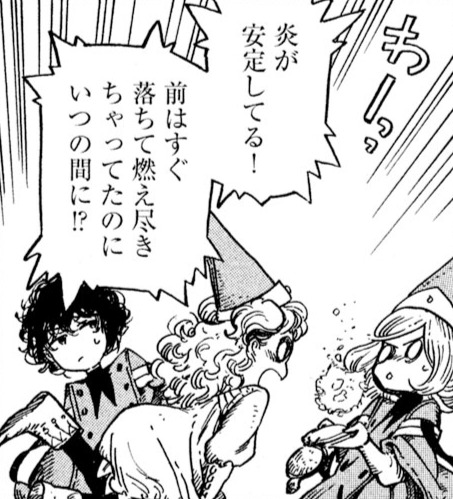
Coco and her friends are trapped in a maze and trying to find a way past a dragon. Seeing the others working out magic to use, Coco tries her hand at a spell, creating a flame. Agott isn’t impressed, but Tetia feels otherwise.
- テティア:
- 「炎が安定してる!」
- “The flame is stable!”
- 「前はすぐ落ちて燃え尽きちゃってたのにいつの間に!?」
- “It used to go out and burn out right away, so when did this happen!?”
- Literal: “Even though it would immediately fall and burn itself out before, when did this happen!?”
Key Points
- Here, 安定してる means the flame is now burning in a steady, controlled way instead of flickering out.
- “してる” is the casual spoken form of している.
- In this scene, it describes the flame’s current state: 「炎が 安定している」 “The flame is stable.”
- が marks the flame as the thing showing this state.
- The sentence is very short because Tetia is reacting excitedly to what she sees.
- 前は sets up a contrast with earlier attempts: before, the flame would quickly fail.
- 落ちて燃え尽きちゃってた is a casual, compressed way to say it used to die down and burn itself out.
- That contrast makes 「安定してる!」 feel like a sudden improvement: “Wait, now it’s stable!?”
Vocabulary
| Word | English | Meaning |
|---|---|---|
| 炎 | Flame | 炎 is a flame or blaze. |
| 安定 | Stability | 安定 means stability, with little risk of sudden change or disruption. |
| 前 | Front | 前 is the front of something. It also means an earlier time, as in 三年前, “three years ago”. |
| すぐ | Right away | すぐ describes something happening immediately, or something very near. |
| 落ちる | To fall | 落ちる is to drop from a higher place. It also means for a fire to die down, or to fail an exam. |
| 燃え尽きる | To burn out | 燃え尽きる is to burn until nothing is left. Of a person, it is to give everything and have no energy left afterward. |
| いつの間に | When did... | いつの間に asks or wonders at what point something happened without being noticed. |
See Also
- Kanji: Peace and ease with 安
- Grammar: Past tense with 〜た・〜だ
- Grammar: Marking the topic with は and も
- Grammar: Ongoing actions and resulting states with 〜ている
- Grammar: Doing completely or ending up doing with 〜てしまう and 〜ちゃう
- Grammar: Even though with 〜のに
- Kanji: Settling and deciding with 定
- Kanji: Spaces and intervals with 間