A submerged town with 水没
Kanji Explanation: Sinking and disappearing with 没
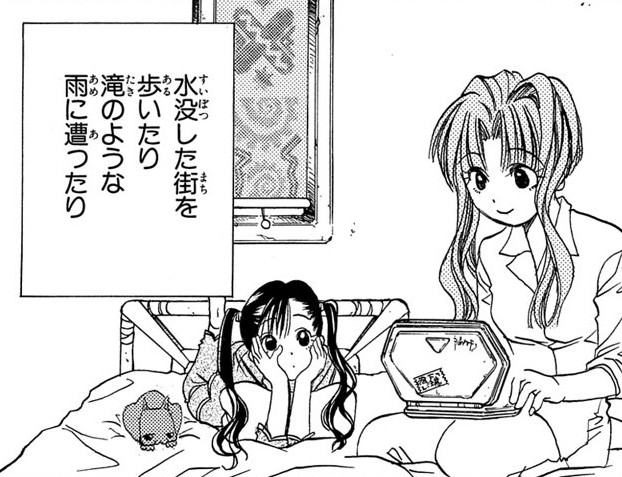
While out buying cat food during acqua alta, when tides have risen onto the streets, Akari is caught in a heavy downpour. She finds herself near Himeya Company, where her friend Aika lives, and she’s invited in to stay the night. As the two watch the falling rain through a window, Akari types an e-mail about her adventure that day.
- 灯里:
- 「水没した街を歩いたり滝のような雨に遭ったり」
- “Walking through a flooded town, getting caught in a downpour...”
- Literal: “Walking through a town that had become submerged, getting caught in rain like a waterfall, and so on...”
She finishes by writing that it was a wonderful adventure and an enjoyable day.
Key Points
- 水没 means being submerged under water, not just getting a little wet
- In this scene, 水没した街 means a town whose streets have gone under water from the rising tide
- 歩いたり and 遭ったり are たり-form verbs used to list representative actions or events
- Basic pattern: Aたり Bたりする “do things like A and B”
- The panel ends on the second 〜たり, and her email continues in the next panel
- 滝のような雨 is a vivid comparison for extremely heavy rain
- 遭う is often used for unpleasant or unexpected experiences, so 雨に遭う is “get caught in the rain” rather than simply “meet rain”
- 水没した modifies 街: “the town that was flooded”
- 滝のような modifies 雨: “rain like a waterfall”
Vocabulary
| Word | English | Meaning |
|---|---|---|
| 水没 | Submersion | 水没 means sinking below the water or becoming submerged. |
| 街 | Town | 街 is a town or city, especially the streets of a busy area. |
| 歩く | To walk | 歩く is to move on foot. |
| 滝 | Waterfall | 滝 is a waterfall, where a river drops down a cliff. |
| ような | Like | ような follows a word to compare something to it: “like” or “such as”. At the end of a sentence, it shows the speaker’s impression. |
| 雨 | Rain | 雨 is rain. |
| 遭う | To encounter | 遭う is to meet with something bad, such as an accident, a storm, or a bad experience. |
See Also
- Kanji: Sinking and disappearing with 没
- Grammar: Past tense with 〜た・〜だ
- Grammar: Marking the direct object with を
- Grammar: Listing example actions with 〜たり〜たりする
- Grammar: Metaphor with 〜ようだ