A submerged town with 水没
Kanji Explanation: Sinking and disappearing with 没
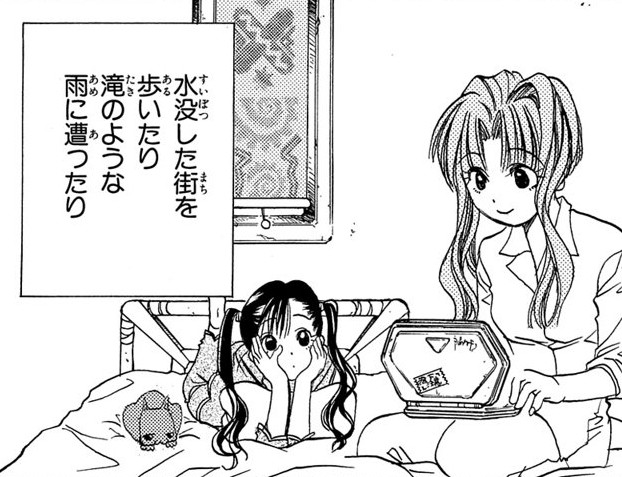
While out buying cat food during acqua alta, when tides have risen onto the streets, Akari is caught in a heavy downpour. She finds herself near Himeya Company, where her friend Aika lives, and she’s invited in to stay the night. As the two watch the falling rain through a window, Akari types an e-mail about her adventure that day.
- 灯里:
- 「水没した街を歩いたり滝のような雨に遭ったり」
- “Walking through a flooded town or getting caught in a downpour...”
- Literal: “Walking through a town that had become submerged, getting caught in rain like a waterfall, and so on...”
She finishes by writing that it was a wonderful adventure and an enjoyable day.
Key Points
1水没した街 = “a town that was submerged / flooded”
- 水没 means being submerged under water, not just getting a little wet
- In this scene, 水没した街 means a town whose streets have gone under water from the rising tide
2〜たり〜たり = listing notable experiences
- 歩いたり and 遭ったり are たり-form verbs used to list representative actions or events
- Basic pattern: Aたり Bたりする “do things like A and B”
- Here the sentence trails off after 〜たり, which gives it a reflective “things like…” feeling as she recounts her day
3滝のような雨に遭う = “to get caught in rain like a waterfall”
- 滝のような雨 is a vivid comparison for extremely heavy rain
- 遭う is often used for unpleasant or unexpected experiences, so 雨に遭う is “get caught in the rain” rather than simply “meet rain”
4How the sentence is built
- 水没した modifies 街: “the town that was flooded”
- 滝のような modifies 雨: “rain like a waterfall”
Vocabulary
水没 (Submersion)
水没 means sinking below the water or becoming submerged.
See Also
- Kanji: Sinking and disappearing with 没
- Future entry: Past tense with 〜た・〜だ
- Grammar: Marking the direct object with を
ARIA The MASTERPIECE © its respective creators. It is used here for educational commentary.