A tomato from the greenhouse with 採れる
Vocabulary Explanation: Taking, catching, and photographing with とる
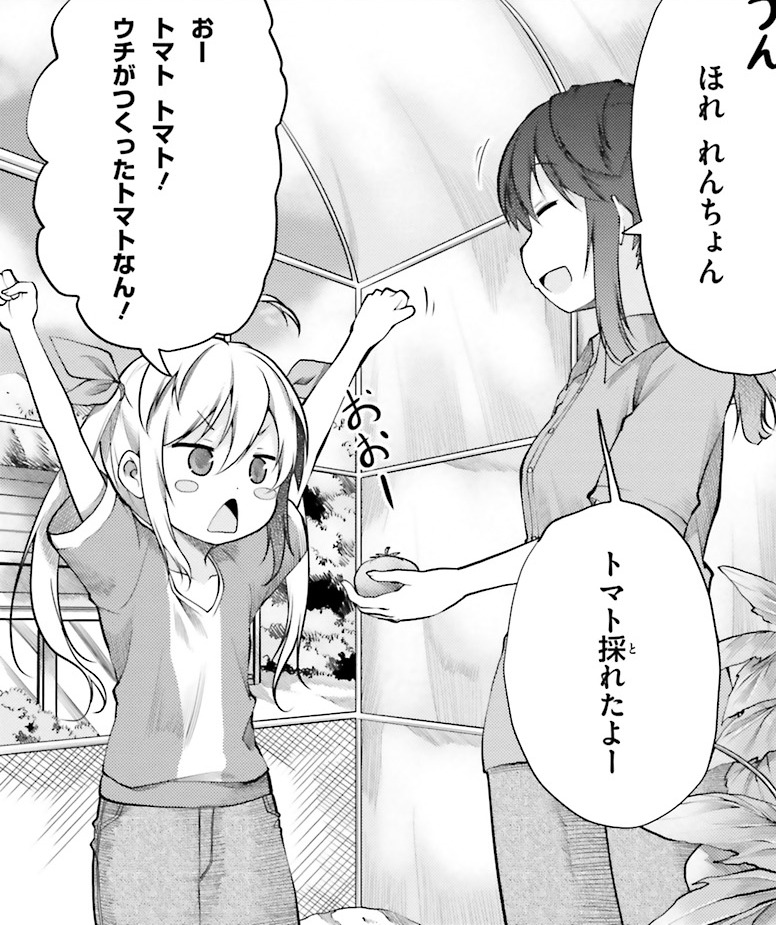
It’s summer, and Kazuho is in the school greenhouse with Renge. She snips a ripe tomato off the vine with a pair of scissors, looks it over, and smiles.
- 一穂:
- 「ほれ れんちょん」
- “Here, Ren-chon.”
- 「トマト採れたよー」
- “The tomatoes are in!”
- れんげ:
- 「おー トマト トマト! ウチがつくったトマトなん!」
- “Ooh! Tomato, tomato! It's the tomato I grew!”
Key Points
1採れる for a harvest
- 採る is “gather” or “pick”, for things that grow, such as mushrooms or wild vegetables. Its partner 採れる makes the crop the subject. トマトが採れる is “tomatoes get harvested”, or “the garden gives tomatoes”.
- Kazuho is the one holding the scissors, but she doesn’t say “I picked”. She says the tomatoes 採れた, as if the plants gave them up. That fits a harvest report. “The tomatoes are in” is close in English.
- The same shape can be the potential, “can pick”. Here nothing is being tested. The tomato is ripe and already cut, so it reads as the harvest itself.
2Why 採 and not 取
- 取 is the default とる, and 取れる usually means “come off” or “come out”, as with a button or a stain. Writing it 取れた could make a reader picture a tomato dropping off the vine.
- 採 is the とる for gathering crops and other things that grow, the 採 of 採集, “collecting”. Farm produce is its home ground, so the writer reaches for it here.
3Dropping が, and news with よー
- Casual speech often drops が, so トマト採れた is トマトが採れた.
- よ tells the listener something new. Stretching it to よー makes it a cheerful call to Renge.
4Handing something over with ほれ
- ほれ is a casual variant of ほら, “here” or “look”, said while handing something over or showing it. Kazuho holds the tomato out as she says it.
5Renge’s ウチがつくった
- ウチ is the “I” Renge uses for herself. ウチがつくったトマト puts a whole clause in front of トマト: “the tomato that I made”. With a plant, つくる is “grow”.
- Renge ends many lines with なん or のん. トマトなん works like トマトなの, an excited “It’s the tomato!”
Vocabulary
| Word | English | Meaning |
|---|---|---|
| トマト | Tomato | トマト is the tomato, eaten raw in salads or cooked into sauces and stews. |
| 採れる | To be harvested | 採れる is for a crop, plant, or other natural product to be gathered or harvested. It also means being able to gather it. |
| ウチ | My home | ウチ is a katakana spelling of うち, “my home”, “my family”, or “our side”. In casual speech, some speakers also use it to mean “I”. |
| つくる | To make; to grow | つくる is a kana spelling of 作る, to make or build something. With crops and plants, it means to grow them, as in トマトをつくる, “grow tomatoes”. |
See Also
- Vocabulary: Taking, catching, and photographing with とる
- Grammar: Past tense with 〜た・〜だ
- Grammar: Informing with よ
のんのんびより © its respective creators. It is used here for educational commentary.