About to go back for it with 〜とこだ
Grammar Explanation: Timing of an action with 〜ところだ
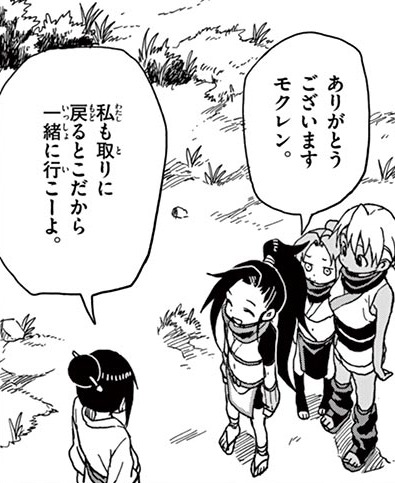
After lunch, Tsubaki is lost in thought when Mokuren calls her over. Mokuren tells her that today’s class will use the second scroll instead of the first.
- ツバキ:
- 「ありがとうございますモクレン。」
- “Thank you, Mokuren.”
- モクレン:
- 「私も取りに戻るとこだから一緒に行こーよ。」
- “I'm just about to go back for mine too, so let's go together.”
Key Points
1About to do something with 〜るとこだ
- A dictionary-form verb plus ところだ says the action is about to start. とこ is the casual, clipped form of ところ.
- Speakers often use it to say the timing works out. Mokuren is heading back anyway, so 一緒に行こーよ follows naturally.
2Going back to get with 取りに戻る
- A verb stem plus に before a verb of motion gives the purpose of the trip. 取り is the stem of 取る, “to get”, and 戻る is “to go back”, so 取りに戻る is “go back to get it”.
- The thing she’s getting goes unsaid. It’s the second scroll from the line before.
3A reason, then an invitation
- から gives the reason, and the main clause invites Tsubaki along. In plain speech, から is the usual choice before an invitation.
- 行こー is the volitional 行こう, “let’s go”, with the long vowel written ー. よ adds a friendly push.
Vocabulary
私 (I)
私 means “I” or “me”. It is the standard first-person pronoun in polite speech and is also common in casual speech among women.
取る (To take)
取る means to take or obtain something. Its exact sense depends on what is being taken.
とこ (Place)
とこ is a casual, shortened form of ところ, “place”.
行く (To go)
行く means to go or move toward a place away from the speaker.
See Also
- Grammar: Timing of an action with 〜ところだ
- Grammar: Because with 〜から
- Grammar: Volitional with 〜う・〜よう
- Grammar: Going to for a purpose with 〜に行く
- Grammar: How casual contractions work
- Kanji: Going and carrying out with 行
- Kanji: Privacy and self with 私
くノ一ツバキの胸の内 © its respective creators. It is used here for educational commentary.