Additionally, I'm happier having girls here with それに〜
Grammar Explanation: In addition to with それに〜
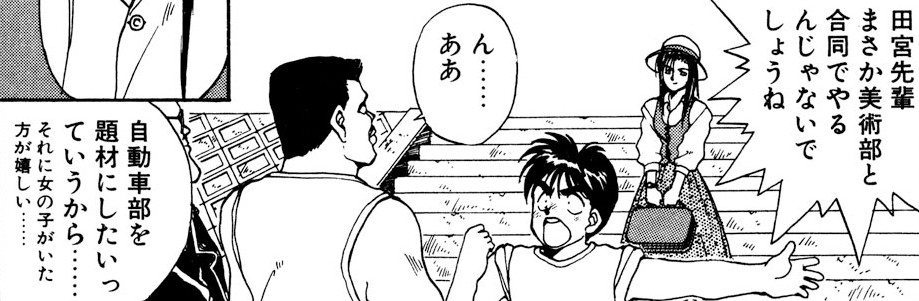
Kei’ichi is excited to spend four days at the beach with his university automobile club and Belldandy. His mood changes when he hears Sayoko call out to him.
- 螢一:
- 「田宮先輩まさか美術部と合同でやるんじゃないでしょうね」
- “Tamiya, don't tell me we're doing this with the art club!”
- Literal: “Tamiya-senpai, surely we aren't doing it jointly with the art club, are we?”
- 田宮:
- 「ん……ああ。自動車部を題材にしたいっていうから…… それに女の子がいた方が嬉しい…」
- “It's because they said they wanted to use the automobile club as a subject... Additionally, I'm happier having girls here.”
- Literal: “Mm... yeah. Because they said they want to make the automobile club their subject... and besides, it would make me happier if girls were there...”
Key Points
- Tamiya first gives the art club’s reason, then uses それに to add his own selfish reason for liking the joint trip.
- 女の子がいた方が嬉しい means “having girls there would make me happier”.
- The 方が pattern sets up a comparison. Tamiya leaves the alternative (no girls around) unstated.
Vocabulary
| Word | English | Meaning |
|---|---|---|
| 先輩 | Senior | 先輩 is a senior member of the same school, workplace, or group, usually someone who joined earlier or has more experience. |
| 美術部 | Art club | 美術部 means an art club, usually at a school. |
| 合同 | Combined | 合同 means joining together or acting jointly, as in a combined group or event. |
| やる | To do | やる is a casual word for “to do”. It also means to give something to someone of lower standing, or to animals and plants. |
| ああ | Ah | ああ is a sound people make when something sinks in, when they sigh, or when they agree. As a reply, it is a casual “yes” or “right”. |
| 自動車 | Automobile | 自動車 is a car or other motor vehicle. It is the formal, general word, while 車 is used in everyday speech. |
| 自動車部 | Automobile club | 自動車部 means an automobile club or department. In the example, it is Keiichi’s university club centered on cars. |
| 部 | Club | 部 is a club, such as a school club. It also means a department or division. |
| 題材 | Subject matter | 題材 is the subject or material that a creative work or study is about. |
| する | To do | する is to do or perform something. It also turns many nouns into verbs, as in 勉強する. |
| 女の子 | Girl | 女の子 is a girl. It is the everyday word, used for children and, casually, for young women too. |
| いる | To be | いる is to exist or be somewhere, for people and animals. After a て-form verb, it shows an ongoing action or a continuing state. |
| 方 | Side | 方 is a direction or side. In comparisons, 〜方がいい means “it’s better to”. Read かた, it is a polite word for a person. |
| 嬉しい | Happy | 嬉しい describes the happy feeling when something good happens to you. |
See Also
- Grammar: In addition to with それに〜
- Grammar: Presuming with 〜だろう and 〜でしょう
- Grammar: Wanting to do with 〜たい
- Grammar: Marking the subject with が
- Grammar: Marking the direct object with を
- Grammar: Quoting and reporting with と and って
- Grammar: More than with 〜方が and 〜より
- Grammar: Seeking agreement with ね
- Grammar: How casual contractions work
- Kanji: Childhood and small things with 子
- Kanji: Joining and fitting with 合
- Kanji: Motion and activation with 動
- Kanji: Sections and departments with 部
- Kanji: Topics and assigned problems with 題
- Kanji: Vehicles and wheels with 車
- Kanji: Women and femininity with 女