Admitting to being forgetful with 〜っぽい
Grammar Explanation: Kind of like with 〜っぽい
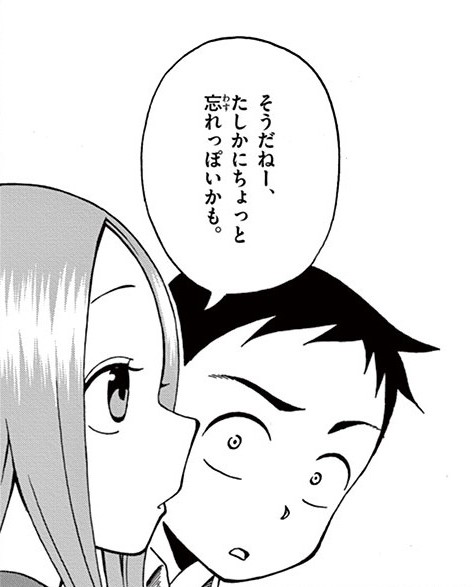
Takagi forgot both her umbrella and her raincoat, so she and Nishikata are walking home together under his umbrella. Hoping to finally tease her for once, Nishikata points out that it’s rare for her to forget anything. He asks whether she’s secretly a klutz.
- 高木:
- 「そうだねー、たしかにちょっと忘れっぽいかも。」
- “Hmm, you're right. I might be a little forgetful.”
Key Points
- 忘れっぽい is the stem of 忘れる, “to forget”, plus っぽい. It describes someone who forgets things easily and often.
- It’s a trait, not one event. Takagi forgot her umbrella and raincoat today, but 忘れっぽい says she’s the kind of person who forgets things.
- Only a few verbs take っぽい this way, such as 忘れっぽい, 怒りっぽい, and 飽きっぽい. Learn them as words.
- そうだね is “that’s right” or “yeah”. The stretched ねー makes it sound thoughtful, as if she’s considering it.
- たしかに is “certainly” or “it’s true”. It accepts the point Nishikata just made.
- ちょっと is “a little”, and かも is short for かもしれない, “might”. かも goes straight after the い-adjective: 忘れっぽいかも.
- Together they make the admission mild. Nishikata expected her to deny it, and her calm agreement is what catches him off guard.
Vocabulary
そう (So)
そう means “like that” or “that way”. Said alone, it agrees: “right”. After a verb stem or adjective, it means something looks or seems a certain way.
たしかに (Certainly)
たしかに agrees that something is true: “certainly” or “that’s true”. It is the kana spelling of 確かに.
ちょっと (A little)
ちょっと describes a small amount or a short time. It also softens a refusal, or calls someone’s attention, like “hey”.
忘れっぽい (Forgetful)
忘れっぽい describes someone who forgets things easily and often.
忘れる (To forget)
忘れる is to forget something. It also means to leave something behind by mistake.
っぽい (-ish)
っぽい follows a word to say something seems like it or tends toward it.
かも (Might)
かも means “might” or “maybe”. It is the casual short form of かもしれない and goes at the end of a sentence to hedge a guess.
See Also
- Grammar: Kind of like with 〜っぽい
- Grammar: Seeking agreement with ね
- Grammar: Might with 〜かもしれない