Akari wants to try fishing with 釣り
Kanji Explanation: Fishing and baiting with 釣
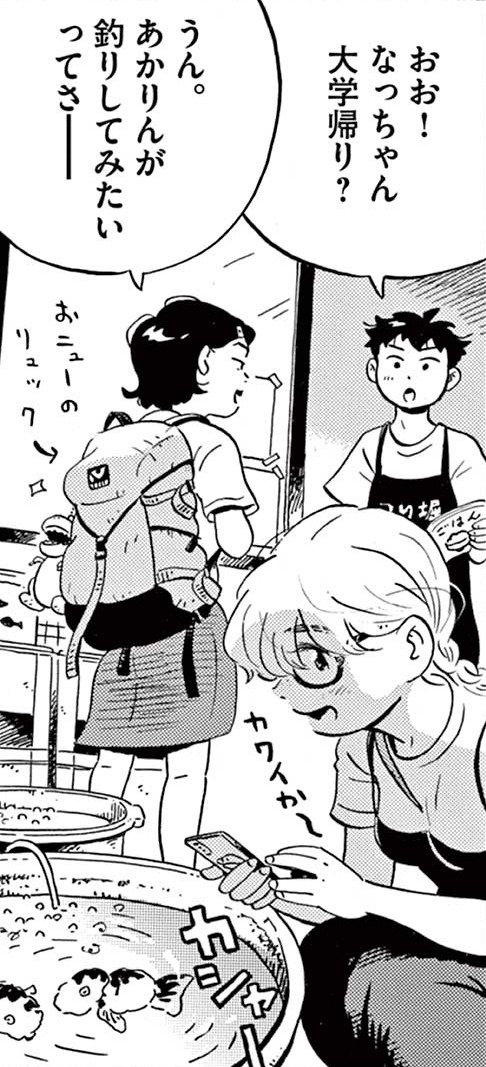
Hiroto works the afternoon shift at a fishing pond in Asagaya, where he mostly minds the counter. Natsumi shows up there with her university friend Akari, who is amazed that a place like this exists in the neighborhood.
- ヒロト:
- 「おお! なっちゃん大学帰り?」
- “Oh! Natsu, on your way back from university?”
- なつみ:
- 「うん。 あかりんが釣りしてみたいってさ――」
- “Yeah. Akari says she wants to try fishing.”
- ー:
- 「おニューのリュック」
- “Brand-new backpack”
- あかり:
- 「カワイか~」
- “So cute...”
Key Points
- 釣り is the noun form of 釣る, “to catch a fish with a hook”. It names the activity, so 釣りする works like “go fishing”.
- In careful speech it would be 釣りをする. Natsumi drops the を, which is normal in casual talk.
- Hiroto’s apron reads つり堀. A 釣り堀 is a pay-to-fish pond, which is where Hiroto works.
- 〜てみる means doing something to see how it goes. Add たい and you get してみたい, “want to try doing”. Akari has never fished and wants to give it a go.
- って quotes, and さ adds a casual push. Together, ってさ at the end of a sentence means “so she says”. Natsumi uses it because the wish is Akari’s, not hers.
- Both are affectionate nicknames. あかりん comes from Akari’s name with a cute ん ending, and Hiroto calls Natsumi なっちゃん.
- Akari speaks a Kyushu dialect, where い-adjectives can end in か. カワイか is her way of saying かわいい while she snaps photos of the goldfish.
Vocabulary
| Word | English | Meaning |
|---|---|---|
| 大学 | University | 大学 is the school you enter after high school, usually for four years. 大学生 is a student there. |
| 帰り | Return trip | 帰り means returning or the journey back. It often refers to the way home after an outing, school, or work. |
| 釣り | Fishing | 釣り is fishing with a rod, line, and hook. In a shop, 釣り, often お釣り, is also the change you get back after paying. |
| する | To do | する is to do or perform something. It also turns many nouns into verbs, as in 勉強する. |
| みる | To see | みる is the kana spelling of 見る, “to see”. After a て-form verb, it means to try doing something to see how it goes. |
| おニュー | Brand-new | おニュー describes something you’ve just bought and are using for the first time, like a new bag or new shoes. |
| リュック | Backpack | リュック is a bag with two shoulder straps that you carry on your back. It is short for リュックサック. |
| かわいい | Cute | かわいい describes someone or something small, sweet, or charming enough to make you feel fond of it. It is also written 可愛い. |
See Also
- Kanji: Fishing and baiting with 釣
- Grammar: Trying it out with 〜てみる
- Grammar: Wanting to do with 〜たい
- Grammar: Casual emphasis with さ
- Kanji: Learning and schooling with 学