All that murder planning for nothing with 水の泡になる
Idiom Explanation: All that effort for nothing with 水の泡になる
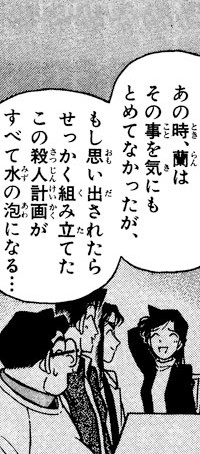
After discovering who the murderer is, Conan explains why the murderer went after Ran. He pinpoints when Ran unknowingly discovered a vital clue.
- コナン:
- 「あの時、蘭の事気にもとめてなかったが、もし思い出されたらせっかく組み立てたこの殺人計画がすべて水の泡になる…」
- “Ran didn't think anything of it at the time, but if she remembered it, all the murderous plans he worked so hard on putting together would go up in smoke.”
- Literal: “At the time, Ran didn't pay it any mind, but if she remembered, this murder plan he had gone to the trouble of assembling would all become bubbles of water...”
Key Points
- This idiom means all the effort would be wasted.
- In the scene, the culprit’s carefully built murder plan would collapse if Ran remembered the clue.
- せっかく組み立てた means “carefully” or “with effort put together”.
- That makes 水の泡になる feel more tragic or frustrating.
- The idea is “if she were to remember it”.
- Everything after that clause is the consequence the culprit wanted to avoid.
Vocabulary
あの (That)
あの comes before a noun to mean “that” or “those”. It points to someone or something away from both speakers, or something they both know about.
時 (Time)
時 means time, a moment, or an occasion.
せっかく (With much effort)
せっかく marks an effort or valuable opportunity that should not go to waste. Depending on the sentence, it can mean “after taking the trouble” or “since we have the chance”.
この (This)
この means “this” or “these” and comes directly before a noun. It points to something near the speaker or something the speaker is referring to in the conversation.
殺人 (Murder)
殺人 means killing another person or murder.
計画 (Plan)
計画 means a plan that sets out what will be done, when, how, and by whom.
See Also
- Idiom: All that effort for nothing with 水の泡になる
- Future entry: Past tense with 〜た・〜だ
- Grammar: Marking the topic with は and も
- Kanji: Counting and planning with 計
- Kanji: People and persons with 人
- Kanji: Pictures and plans with 画