Almost swept up with 〜ところだった
Grammar Explanation: Timing of an action with 〜ところだ
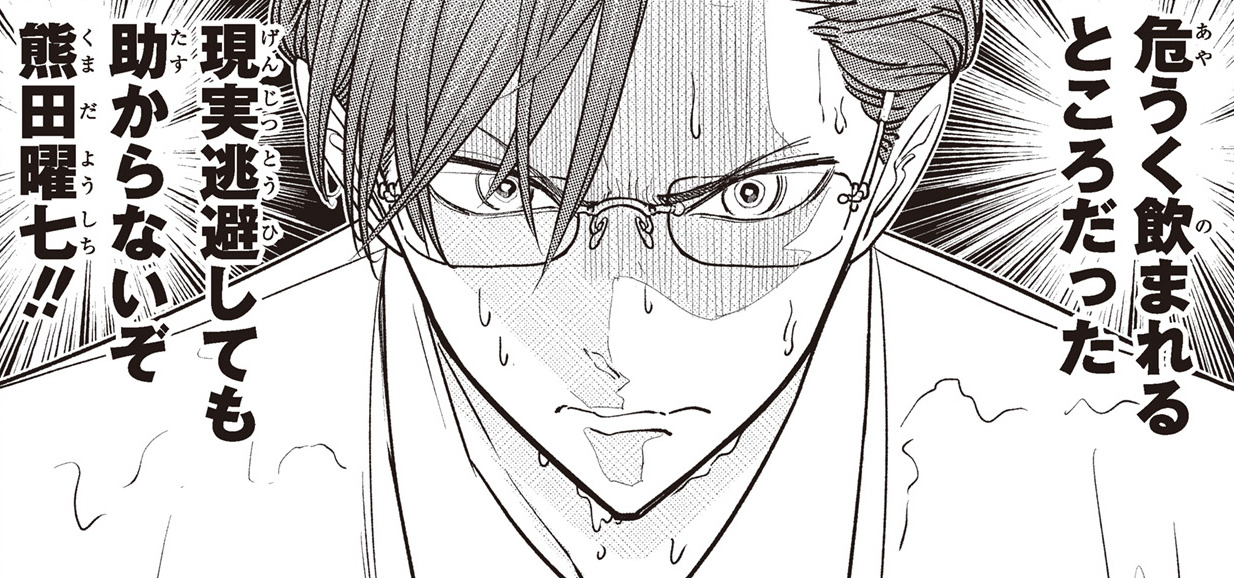
Kumada, a man who plans his whole life around avoiding risk, comes home to find a bear in his apartment. He’s sure he’s about to die, but the bear sets out beer and snacks for him instead. Remembering a documentary about a man and a lion, Kumada wonders if the bear is a partner sent to comfort him, and it starts to look rather cute. Then he takes another look at its face, and it’s terrifying.
- 熊田:
- 「危うく飲まれるところだった」
- “That was close. I almost got swept up in it.”
- 「現実逃避しても助からないぞ熊田曜七!!」
- “Running from reality won't save you, Kumada Youshichi!!”
Key Points
- A dictionary-form verb plus ところだ marks the point just before an action. ところだった puts that point in the past. Here it means the action almost happened but didn’t.
- 危うく (“narrowly”) makes the close-call reading clear. It’s used for bad outcomes that were only just avoided, and Kumada is relieved to have escaped this one.
- 飲まれる is the receptive (passive) form of 飲む. Besides “drink”, 飲む can mean “swallow”, so 飲まれる is “be swallowed”.
- Figuratively, 飲まれる means getting swept along by a mood or situation, as in 雰囲気に飲まれる, “get swept up in the atmosphere”. Kumada was getting swept up in his own heartwarming fantasy. With a bear in the room, the literal sense of being swallowed whole makes it a fitting word.
- 現実逃避しても is the て-form of 現実逃避する plus も, “even if you escape reality”.
- 助からない is the negative of 助かる, “to be saved”. Together, the line says daydreaming won’t get him out of danger.
- Kumada addresses himself by his full name and ends with the rough, emphatic ぞ. It’s the tone of a stern warning, aimed at himself.
Vocabulary
危うく (Nearly)
危うく means “nearly” or “narrowly”, for a bad outcome that almost happened. It often pairs with 〜ところだった, as in 危うく車にひかれるところだった, “I nearly got hit by a car”.
飲む (To drink)
飲む is to drink something, or to take medicine.
ところ (Place)
ところ is a place or spot. It also refers to a point in time or a certain aspect of something. It is also written 所.
する (To do)
する is to do or perform something. It also turns many nouns into verbs, as in 勉強する.
助かる (To be saved)
助かる means to be saved or rescued from danger, or to escape harm. In everyday speech it also means to be spared trouble, as in 助かります, “that really helps”.
ぞ ((emphatic ending))
ぞ is a sentence-ending particle that adds force to a statement, warning, or resolution. It sounds rough and assertive, and men use it more often.
See Also
- Grammar: Timing of an action with 〜ところだ
- Grammar: Receptive verbs with 〜れる
- Grammar: Even if with 〜ても
- Grammar: Rough declarations with ぞ and ぜ