Am I a caught fish with 釣る
Kanji Explanation: Fishing and baiting with 釣
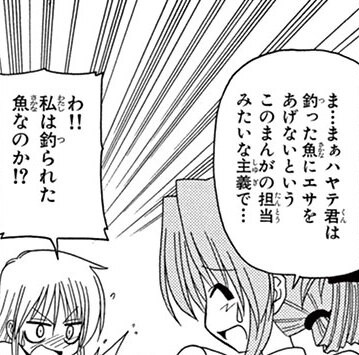
Nagi believes Hayate once confessed his love for her, though it was a misunderstanding. Hayate recently saw her hanging out with another boy and said nothing, and she’s upset that he doesn’t seem jealous. In the bath, she asks Maria why Hayate never gets even a little jealous, when he was the one who said he liked her.
- マリア:
- 「ま…まぁハヤテ君は釣った魚にエサをあげないというこのまんがの担当みたいな主義で…」
- “W-well, maybe Hayate is like this manga's editor, and doesn't believe in feeding a fish once it's caught...”
- ナギ:
- 「わ!! 私は釣られた魚なのか!?」
- “Wh-! So I'm a fish that's already been caught?!”
Key Points
- 釣った魚に餌をやらない, “not feeding a fish you’ve already caught”, describes someone who works hard to win a partner and then stops making an effort.
- Maria softens やらない to あげない, and she adds a jab at the series itself. 担当 here means the manga’s editor, who supposedly follows the same principle with the author.
- 釣る means “to catch a fish”. In Maria’s line, 釣った魚 is the fish someone has caught.
- Nagi turns the verb around. 釣られた is the passive past: “was caught”. 釣られた魚 is herself, a fish that has already been landed.
- Taking the saying’s fish personally is what makes her so upset.
- なのか asks whether something is really the case. It’s blunt and casual, and Nagi’s alarm shows in the !?.
- 主義 is a principle someone lives by. 〜という主義 is “the principle that …”.
Vocabulary
| Word | English | Meaning |
|---|---|---|
| 君 | You | 君 is a word for “you” used toward equals or people younger or of lower standing. It sounds gentle or poetic. Read くん, it is a suffix on names. |
| 釣る | To fish | 釣る is to catch a fish with a hook and line. It also means to lure a person with something they want, as in 餌で釣る. |
| 魚 | Fish | 魚 is a fish. |
| エサ | Bait | エサ is food given to animals or put on a hook to catch fish. It is the katakana spelling of 餌. |
| あげる | To give | あげる is to give something to someone else. After a て-form verb, it means doing something for someone. It also means to raise something. |
| この | This | この means “this” or “these” and comes directly before a noun. It points to something near the speaker or something the speaker is referring to in the conversation. |
| まんが | Manga | まんが is the kana spelling of 漫画, stories told in drawn panels with speech balloons. |
| 担当 | Charge | 担当 is being responsible for a particular task or area, such as a class, a customer, or a section of work. |
| みたい | Like | みたい follows a word to compare something to it: “like” or “similar to”. It also means “it seems”. |
| 主義 | Doctrine | 主義 is a principle a person or group lives by. After a noun it works like “-ism”, and 主義じゃない means “it’s against my policy”. |
| 私 | I | 私 means “I” or “me”. It is the standard first-person pronoun in polite speech and is also common in casual speech among women. |
See Also
- Kanji: Fishing and baiting with 釣
- Grammar: Receptive verbs with 〜れる
- Grammar: Likening things with 〜みたい
- Grammar: Reasoning with 〜のだ
- Kanji: Matching and appropriateness with 当
- Kanji: Privacy and self with 私