Amazed by Ran with 〜される
Grammar Explanation: Being made to do with 〜させられる
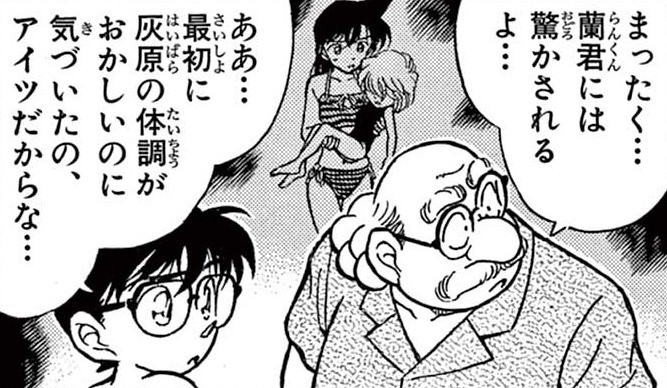
Professor Agasa takes Conan and the other kids to a beach in Izu, where they run into Ran and Sonoko. When Haibara says she’s tired, Ran comes ashore with her and Conan, and Haibara turns out to have sunstroke. Once Haibara starts to recover, Ran tells her to speak up the next time she feels sick, and heads back to join the others.
- 阿笠:
- 「まったく…蘭君には驚かされるよ…」
- “Honestly... Ran never stops amazing me...”
- コナン:
- 「ああ…最初に灰原の体調がおかしいのに気づいたの、アイツだからな…」
- “Yeah... She's the one who noticed something was wrong with Haibara first.”
- Literal: “Yeah... The one who first noticed Haibara's condition was off was her, after all...”
Key Points
- 驚く is “be surprised”. 驚かされる is its short causative-receptive. It means the surprise was brought on by someone else.
- It can also be read as the plain receptive of 驚かす, “surprise (someone)”. Either way, the meaning is the same.
- The feeling here is a positive one. Agasa is impressed, and まったく sounds like an admiring shake of the head.
- に marks the person who brought on the feeling, and は sets Ran apart as the topic: “when it comes to Ran”.
- Agasa uses the nonpast 驚かされる, not 驚かされた. He’s talking about Ran in general, not just today: “Ran always amazes me”.
- This のに isn’t “even though”. の turns 体調がおかしい into a noun, “that her condition was off”, and に marks it as what Ran noticed with 気づく.
- The second の, in 気づいたの、アイツだ, also turns a clause into a noun: “the one who noticed is her”. The topic particle は after it is dropped, as it often is in speech.
- アイツだからな ends in から, giving the reason behind Agasa’s surprise. な makes it a casual remark, and アイツ is a familiar way to refer to Ran.
Vocabulary
まったく (Completely)
まったく means “completely” or “entirely”. With a negative, it means “not at all”. Said on its own, it shows exasperation or amazement, like “honestly” or “good grief”. It is also written 全く.
君 (You)
君 is a word for “you” used toward equals or people younger or of lower standing. It sounds gentle or poetic. Read くん, it is a suffix on names.
驚く (To be surprised)
驚く is to be surprised, startled, or amazed by something unexpected.
ああ (Ah)
ああ is a sound people make when something sinks in, when they sigh, or when they agree. As a reply, it is a casual “yes” or “right”.
おかしい (Strange)
おかしい describes something that seems off or not right. It also means funny or amusing.
気づく (To notice)
気づく means to notice something or become aware of it. It can also mean to come to after losing consciousness. It is also written 気付く.
アイツ (That guy)
アイツ is あいつ written in katakana. It refers casually to a person who isn’t part of the conversation, or sometimes to a thing, and can sound rough or familiar.
See Also
- Grammar: Being made to do with 〜させられる
- Grammar: Because with 〜から
- Kanji: Body and substance with 体