An accomplice in sharing lunch with 共犯
Kanji Explanation: Crimes and offenders with 犯
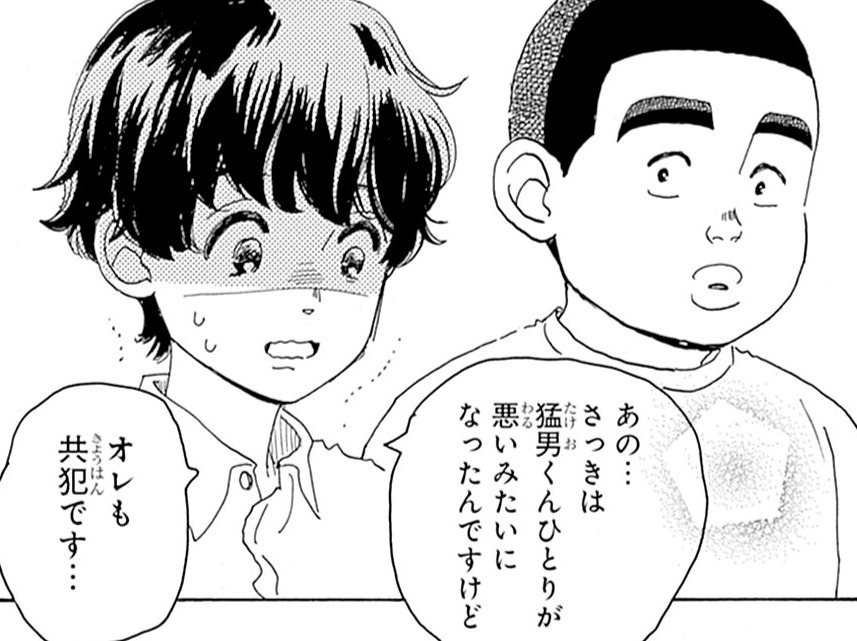
Yacchin eats little and dislikes many foods, so his friend Takeo helps by eating the parts of his lunch he doesn’t like. A teacher catches sight of this and yells at them not to give or take food from one another. When the coast is clear, Takeo continues, only to be sighted and punished by the teacher. Yacchin goes up to the teacher afterward.
- やっちん:
- 「あの… さっきは猛男くんひとりが悪いみたいになったんですけどオレも共犯です…」
- “Um... It seemed like Takeo was the only one at fault just now, but I was in on it too...”
- Literal: “Um... Just now it ended up looking like Takeo alone was at fault, but I am also his accomplice...”
Key Points
- 共 means together, and 犯 points to an offense or rule-breaking act.
- オレも means “me too” or “I also” in a casual, masculine-sounding voice.
- 悪いみたいになった means “it ended up seeming like he was at fault”.
- The wording avoids accusing the teacher directly. Yacchin presents it as the impression that formed, not as a blunt claim that the teacher blamed Takeo.
- なったんですけど gives background before the main point: “it ended up seeming that way, but…”
- The けど leaves room for the correction that follows: オレも共犯です.
- The sentence ends in です because Yacchin is speaking to a teacher.
- 君 is an honorific suffix used after names, typically for boys or men. It’s commonly used by teachers addressing male students, by friends among young people, or by superiors addressing junior colleagues, and can also be used for girls in childhood or casual contexts.
Vocabulary
あの (That)
あの comes before a noun to mean “that” or “those”. It points to someone or something away from both speakers, or something they both know about.
悪い (Bad)
悪い means bad, wrong, or at fault. In conversation, it can also express an apology.
見る (To see)
見る means to see or look at something. It can also mean to examine its condition or nature.
共犯 (Accomplice)
共犯 means complicity in a crime or an accomplice who takes part in it.
See Also
- Kanji: Crimes and offenders with 犯
- Grammar: Likening things with 〜みたい
- Grammar: Reasoning with 〜のだ
- Future entry: Past tense with 〜た・〜だ
- Grammar: Marking the topic with は and も