An elaborate bento with 手の込み方
Vocabulary Explanation: Crowds and packing in with こむ
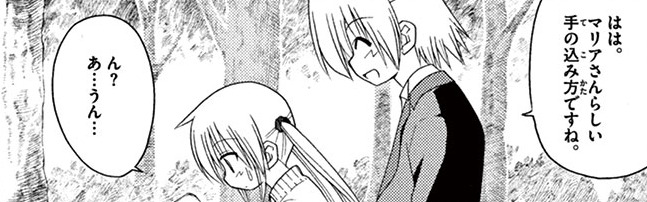
Hayate and Nagi stop on a mountain trail to eat the bento Maria sent with them. Nagi carried it the whole way and grumbles that she’ll complain to Maria if it isn’t delicious. When they open it, the rice is shaped into a bear and a rabbit, and the words がんばったね, “You did your best”, are spelled out across the top.
- ハヤテ:
- 「はは。マリアさんらしい手の込み方ですね。」
- “Haha. It's elaborate, just like Maria.”
- ナギ:
- 「ん? あ…うん…」
- “Hm? Oh... yeah...”
Key Points
- 手の込んだ describes something elaborate that took a lot of work, such as a dish, a gift, or a trick. Here, the 込む is the “intricate” one, written with 込 and never 混.
- Swapping the verb’s ending for 〜方 turns it into a noun for the way something is done. 手の込み方 is how much work went into the bento.
- After a person’s name, らしい means the thing is typical of that person. Hayate isn’t guessing or reporting what he heard. He’s saying the bento shows Maria’s usual care.
- Like an い-adjective, マリアさんらしい comes right before the noun it describes, 手の込み方.
- Hayate speaks politely to Nagi, his employer, so he ends with です. ね invites her to agree that the bento is very much Maria’s work.
- Nagi answers with a distracted ん? あ…うん…, still caught up in the bento.
Vocabulary
| Word | English | Meaning |
|---|---|---|
| 手 | Hand | 手 is a hand. It also means a way or means, or help from someone. |
| 込む | To be crowded, to be intricate | 込む is for things piling up or being intricate, as in 手の込んだ, “elaborate”, and 負けが込む, “rack up losses”. It also means a place is crowded, though that sense is usually written 混む. After another verb’s stem, 〜込む means “into” or “thoroughly”. |
| 方 | Side | 方 is a direction or side. In comparisons, 〜方がいい means “it’s better to”. Read かた, it is a polite word for a person. |
See Also
- Vocabulary: Crowds and packing in with こむ
- Grammar: Polite style with です and ます
- Grammar: Seeking agreement with ね
- Kanji: Hands and skill with 手