An incompetent officer with 無能
Kanji Explanation: Ability and capability with 能
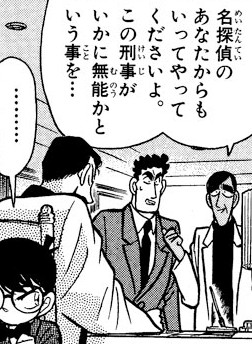
Police detective Yokomizo isn’t about to let Sasai, his prime murder suspect, leave. Sasai reminds the officer that he has photographic proof that he wasn’t near the victim at the time of the murder. He calls for Detective Mouri to back him up.
- 笹井:
- 「名探偵のあなたからもいってやってくださいよ。 この刑事がいかに無能かという事を…」
- “You, the great detective, should tell him yourself. Just how incompetent this police detective is...”
- Literal: “You, the great detective, tell him too, please. The matter of just how incompetent this detective is...”
Key Points
- Here 無能 is a direct insult aimed at the detective.
- It strongly says he is useless at his job.
Vocabulary
| Word | English | Meaning |
|---|---|---|
| 名探偵 | Great detective | 名探偵 means a great or renowned detective, especially one known for solving difficult cases. |
| あなた | You | あなた is a polite word for the person you are speaking to. Japanese speakers often avoid it and use the person’s name or title instead. A wife may also call her husband あなた. |
| いう | To say | いう is to put something into words. It is the kana spelling of 言う and appears in phrases like という, which introduces a name or a quoted idea. |
| やる | To do | やる is a casual word for “to do”. It also means to give something to someone of lower standing, or to animals and plants. |
| この | This | この means “this” or “these” and comes directly before a noun. It points to something near the speaker or something the speaker is referring to in the conversation. |
| 刑事 | Detective | 刑事 means a police detective who investigates crimes and arrests suspects. |
| いかに | How | いかに stresses degree, like “just how” or “how very”. It sounds more formal than どんなに. |
| 無能 | Incompetent | 無能 means incompetent or incapable. It can describe a person or the lack of ability itself. |
| 事 | Thing | 事 is an abstract thing, matter, or fact. It also turns a verb phrase into a noun, as in 見た事がある. It is often written こと. |
See Also
- Kanji: Ability and capability with 能
- Grammar: Marking the topic with は and も
- Grammar: Receiving kindness with 〜てくれる
- Grammar: Quoting and reporting with と and って
- Grammar: Marking the direct object with を
- Grammar: Doing for someone with 〜てあげる
- Grammar: Informing with よ
- Kanji: Absence and nothingness with 無
- Kanji: Matters and events with 事
- Kanji: Searching and probing with 探