An invitation to go smelt fishing with ワカサギ釣り
Kanji Explanation: Fishing and baiting with 釣
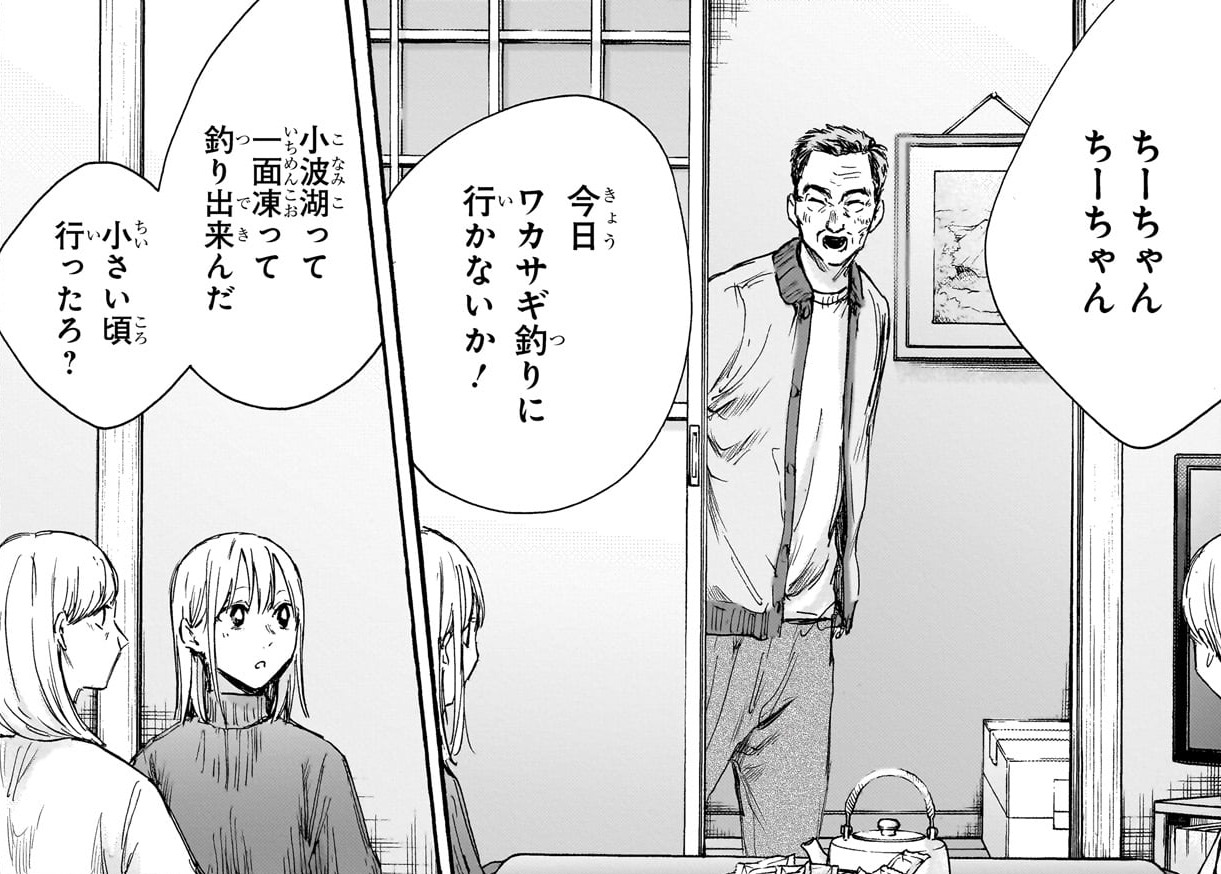
Chinatsu is spending the New Year holidays at her grandparents’ house in Nagano. One morning she sits at the kotatsu with her mother, who tells her they’ll head home on the sixth and can take it easy until then. Then her grandfather calls to her from the doorway.
- おじいちゃん:
- 「ちーちゃん ちーちゃん」
- “Chii, Chii!”
- 「今日ワカサギ釣りに行かないか!」
- “Want to go smelt fishing today?”
- 「小波湖って一面凍って釣り出来んだ」
- “Konami Lake freezes over end to end, so you can fish right on it.”
- 「小さい頃行ったろ?」
- “We went when you were little, remember?”
Key Points
- 釣り is the noun “fishing”. A fish’s name in front of it says what you’re after. ワカサギ is the pond smelt, a small, slender fish, and ワカサギ釣り is a winter pastime where people drill holes in lake ice and drop lines through them.
- The dictionary doesn’t list ワカサギ釣り as one word, so read it as ワカサギ + 釣り.
- 釣りに行く is “go fishing”. に after an activity noun marks the purpose of going.
- A negative question like 行かないか works as an invitation: “won’t you go?” or “how about going?” Ending on か with an exclamation mark is a hearty, older-man way to say it.
- 釣り出来る is 釣りが出来る, “you can fish”, with が dropped in casual speech.
- 出来んだ is a contraction of 出来るんだ, which explains why the frozen lake is worth the trip.
- 行ったろ is a casual 行っただろ. Rising at the end, it asks her to confirm: “we went, didn’t we?”
Vocabulary
| Word | English | Meaning |
|---|---|---|
| 今日 | Today | 今日 means today. In formal writing, it can also mean the present day or current era. |
| ワカサギ | Pond smelt | ワカサギ is the Japanese pond smelt, a small, slender lake fish. In winter, people catch it through holes cut in lake ice. |
| 釣り | Fishing | 釣り is fishing with a rod, line, and hook. In a shop, 釣り, often お釣り, is also the change you get back after paying. |
| 行く | To go | 行く means to go or move toward a place away from the speaker. |
| 一面 | The whole surface | 一面 is the whole surface or expanse of something, as in 一面の雪, “snow as far as the eye can see”. It can also mean one side or aspect, or a newspaper’s front page. |
| 凍る | To freeze | 凍る is for water or another liquid to turn solid from the cold. 湖が凍る is “a lake freezes over”. |
| 出来る | To be able to | 出来る means to be able to do something. It can also mean that something is made, completed, or comes into existence. |
| 小さい | Small | 小さい describes something small in size. 小さいころ means “when one was little”. |
| 頃 | Time, days | 頃 is a period or point in time, as in 子どもの頃, “when I was a child”. After a time expression it is read ごろ and means “around”, as in 三時頃. |
See Also
- Kanji: Fishing and baiting with 釣
- Grammar: Going to for a purpose with 〜に行く
- Grammar: Reasoning with 〜のだ
- Grammar: How casual contractions work
- Grammar: Presuming with 〜だろう and 〜でしょう
- Kanji: Faces and surfaces with 面
- Kanji: Going and carrying out with 行
- Kanji: Going out and emerging with 出
- Kanji: Now and the present with 今