Anyone had the chance with つまり〜わけだ
Grammar Explanation: Logical conclusion with 〜わけだ
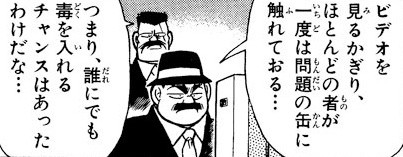
Ran and Sonoko’s middle school teacher collapsed at her wedding after drinking lemon tea laced with caustic soda. The poison was sealed in a capsule that dissolved slowly, so the police can’t pin down when it went into the can. Ran and Sonoko had left a video camera running in the bride’s room, and Inspector Megure has just used the footage to list when each visitor was with her.
- 目暮:
- 「ビデオを見るかぎり、ほとんどの者が一度は問題の缶に触れておる…」
- “As far as the video shows, almost everyone touched the can in question at least once...”
- 「つまり、誰にでも毒を入れるチャンスはあったわけだな…」
- “In other words, anyone had a chance to put the poison in...”
Key Points
- わけだ presents a statement as following from facts already in hand. Here the fact is the first sentence: almost everyone touched the can.
- Megure doesn’t add new information. He restates that fact from another angle, as what it means for the investigation. つまり at the start signals the restatement.
- な after わけだ makes it sound like he’s confirming the conclusion to himself as much as to the others.
- A question word plus でも means “any”: 誰でも is “anyone”. When a particle is needed, it goes between them, so に gives 誰にでも.
- The に marks who the chance belongs to, as in 彼にチャンスがある, “he has a chance”. 誰にでもチャンスはあった is “anyone had a chance”.
- かぎり (限り) after a verb like 見る sets the limit of what the speaker is basing a statement on. ビデオを見るかぎり is “as far as the video shows”.
- It leaves room for what the video didn’t capture, which suits a detective weighing evidence.
- おる is a variant of いる. In casual speech, older men in manga often use 〜ておる where others would say 〜ている.
- Megure uses it here in place of 触れている, “have touched”.
Vocabulary
ビデオ (Video)
ビデオ is a video recording, or the videotape or recorder used to make and play one.
見る (To see)
見る is to see, look at, or watch something. It also means to check or judge something, or to look after someone, as in 面倒を見る.
かぎり (As far as)
かぎり, also written 限り, means a limit. After a verb, it sets the range a statement covers, as in 見るかぎり, “as far as (one) can see”, or the condition it holds under, “as long as”.
ほとんど (Almost all)
ほとんど means almost all or nearly. As a noun, ほとんどの〜 is “most of” or “almost every”. With a negative verb, it means hardly or barely.
者 (Person)
者 is a person. It is a formal or rough word, as in 部下の者, “one of my men”.
一度 (Once)
一度 is one time or one occurrence. It also refers to a time in the past: “once”.
缶 (Can)
缶 is a metal can or tin, such as a drink can.
触れる (To touch)
触れる means to touch or come into contact with something. It also means to mention or touch on a topic.
おる (To be)
おる is a humble or polite form of いる. In western Japanese dialects, it is the everyday word for いる, and after a て-form verb it shows an ongoing action.
つまり (In other words)
つまり introduces a restatement or conclusion of what was just said: “in other words”, “in short”, “so”. It often comes before a sentence ending in わけだ or ということだ.
誰 (Who)
誰 asks which person.
毒 (Poison)
毒 means poison. It also describes anything harmful, including a corrupting influence or malicious words.
入れる (To put in)
入れる is to put something inside something else. It also means to let someone in, or to make tea or coffee.
チャンス (Chance)
チャンス is an opportunity or good chance to do something.
ある (To exist)
ある is to exist or be in a place, for things and plants rather than people or animals. It also means to have something, or for an event to take place.
わけ (Reason)
わけ is a reason or meaning. It also appears in grammar patterns such as わけがない, “there’s no way”, and わけにはいかない, “can’t very well”.