Arranged to assist in a lab with 〜ことになる
Grammar Explanation: To end up being with 〜ことになる
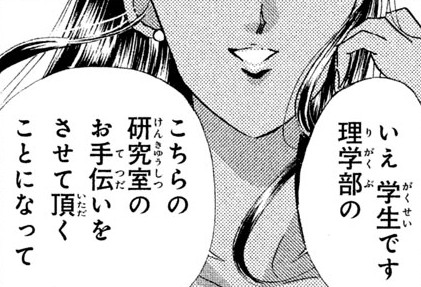
Reika sees an unknown person in the old lab next to her class’s. She asks the woman if she’s an assistant.
- せつな:
- 「いえ 学生です理学部の」
- “No, I'm a student, in the science department.”
- 「こちらの研究室のお手伝いをさせて頂くことになって」
- “It's arranged for me to help out in this lab.”
- Literal: “It has become the thing that I will be allowed to help with this lab.”
Key Points
- 〜ことになる says that a decision or arrangement has come about.
- Here Setsuna explains her role as something already arranged, not as a sudden personal whim.
- お手伝いをさせて頂く literally frames the help as something she is allowed to do.
- A fuller version would be ことになりまして, the polite て-form, with “so I’m here” left unsaid.
Vocabulary
学生 (Student)
学生 means a student, especially at a school or university.
理学部 (Faculty of Science)
理学部 is the university faculty of natural sciences, such as physics, chemistry, and biology.
こちら (This way)
こちら is a polite word for “here”, “this way”, or “this one”. It can also politely mean “I” or “we”.
研究室 (Laboratory)
研究室 means a laboratory or research office. At a university, it often means a professor’s lab.
させる (To make someone do)
させる is the causative form of する. It means to make someone do something or to let them do it.
頂く (To receive)
頂く is a humble way to say you receive something. After させて, it politely asks or announces that one will do something.
こと (Thing)
こと is an abstract thing, matter, or fact, as opposed to a physical object. It also turns a verb phrase into a noun, as in 見たことがある. It is also written 事.
なる (To become)
なる is to change into a different state or become something. It also means something turns out a certain way. It is also written 成る.
See Also
- Grammar: To end up being with 〜ことになる
- Grammar: Having someone do something with 〜てもらう
- Grammar: Making and letting with 〜せる・〜させる
- Kanji: Hands and skill with 手
- Kanji: Learning and schooling with 学
- Kanji: Sections and departments with 部