As if to say try and catch me 〜んばかり
Grammar Explanation: As if with 〜んばかり
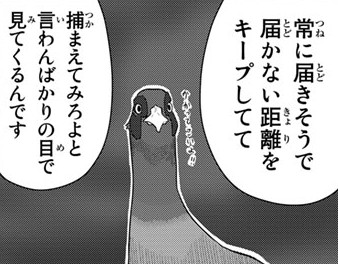
Kei and Chinatsu watch as their cousin, Makoto, chases a pheasant back and forth across the field. During a break in the chase, Makoto explains her fascination with the bird.
- 真琴:
- 「常に届きそうで届かない距離をキープしてて」
- “Constantly seeming like you can reach and keeping a distance you can't...”
- 「捕まえてみろよと言わんばかりの目で見てくるんです」
- “It's been looking with eyes as if to say, try and catch me!”
- Literal: “It looks at me with eyes as if saying, 'try catching me'.”
Key Points
1〜んばかり describes something almost expressed
- 言わんばかり means the bird is not literally speaking, but its eyes look as if they are saying something.
- The negative-looking わん is an older/literary form of 言わない, used inside this fixed pattern.
2The quoted idea is what the eyes seem to say
- 「捕まえてみろよ」 is the taunting message Makoto reads into the bird’s look.
- よ gives the imagined challenge a bold, teasing feel.
3見てくるんです adds perceived pressure
- 見てくる means the look is directed toward Makoto, not just that the bird is looking somewhere.
- んです presents this as her explanation for why the chase feels so compelling.
Vocabulary
距離 (Distance)
距離 refers to the “gap” or “length” between two places, things, or people.
見る (To see)
見る means to see or look at something. It can also mean to examine its condition or nature.
See Also
- Grammar: As if with 〜んばかり
- Grammar: Trying it out with 〜てみる
- Grammar: The plain imperative
- Grammar: Connecting actions with 〜て・〜で
- External: Japanese literary expression: ~言わんばかり (~iwan bakari) (selftaughtjapanese.com)
- Kanji: Distances and range with 距
ふらいんぐうぃっち © its respective creators. It is used here for educational commentary.