As long as my notebook is neat with 〜さえ
Grammar Explanation: Even and as long as with 〜さえ
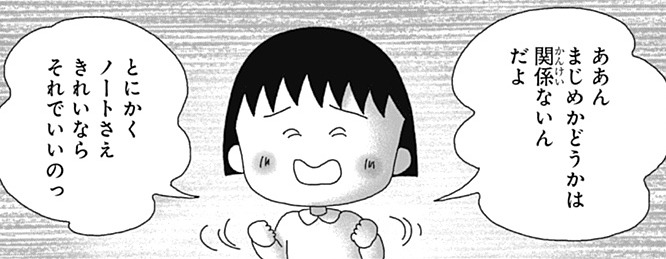
Maruko’s classmates showed off their neatly kept notebooks, and Maruko, who has never put any effort into hers, wants to fix hers before anyone asks to see it. Her older sister’s notebook turns out to be beautiful, and Maruko wonders how two sisters raised by the same parents ended up so different. Her sister says she, at least, doesn’t forget her homework or show up late, and that if Maruko lived a little more seriously, her notebook might get neater too.
- まる子:
- 「ああん まじめかどうかは関係ないんだよ」
- “Ugh, whether I'm serious or not has nothing to do with it!”
- 「とにかくノートさえきれいならそれでいいのっ」
- “Look, as long as my notebook is neat, that's all I need!”
Key Points
- さえ in a conditional means “as long as” or “if only”. It marks the one thing that’s needed. If that one thing holds, the rest doesn’t matter.
- Here the condition is きれいなら, the な-adjective きれい with the conditional なら. The pattern is noun + さえ + な-adjective + なら.
- さえ replaces が. The plain version is ノートがきれいなら, “if my notebook is neat”. Adding さえ makes the notebook the only thing that counts.
- それ points back to the condition, a neat notebook. で is the て-form of the copula, and いい is “good”. Together, それでいい is “that’s fine” or “that’s good enough”.
- It often follows a さえ〜ば or さえ〜なら clause to say the one condition is all that’s needed.
- いいの ends on a casual の with no だ. Children often use it when they insist on something, and the small っ cuts it off sharply. いいのっ is a pouting “that’s all I need!”
- In her first line, 関係ないんだよ uses んだ, the casual form of のだ, to push back on her sister’s point. よ aims it at her sister.
- まじめかどうか is “whether (I’m) serious or not”. か turns a yes-or-no question into a noun phrase, and どうか adds “or not”.
- With は and 関係ない, it means “whether I’m serious has nothing to do with it”. Her sister has just tied a neat notebook to living seriously, and Maruko rejects that link.
Vocabulary
まじめ (Serious)
まじめ describes someone who is earnest and does things properly, such as studying hard, keeping rules, and not fooling around. It is the kana spelling of 真面目.
ない (Not)
ない means something does not exist or someone does not have it. After a verb, it makes the verb negative. It is also written 無い.
とにかく (Anyway)
とにかく sets other matters aside to focus on the main point: “in any case”.
ノート (Notebook)
ノート is a notebook, especially one used for taking notes at school. It can also mean the notes written in it.
きれい (Pretty)
きれい describes something beautiful to look at, or something clean and neat. It is also written 綺麗.
それ (That)
それ points to something near the listener, or to something just mentioned.
いい (Good)
いい describes something good, nice, or fine. It can also mean “okay” or “that’s enough”. Its other forms come from よい, as in よくない and よかった.
See Also
- Grammar: Even and as long as with 〜さえ
- Grammar: Reasoning with 〜のだ
- Grammar: If that's the case with なら