Asking about a nearby tackle shop with 釣具
Kanji Explanation: Fishing and baiting with 釣
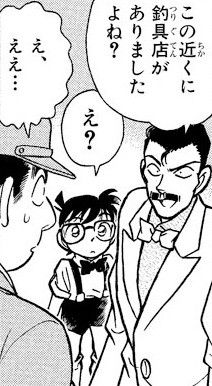
An illustrator, Izumi Chouno, fell from her apartment balcony while Kogoro, Ran, and Conan watched from her boss’s design office a few dozen meters away. The police are calling it suicide, but Conan has figured out how the killer made it look that way. He wants Kogoro to see it too, so he shows him a fishing line and tells him it was in the balcony drain. Kogoro’s eyes go wide, and he says it reminds him of something.
- 小五郎:
- 「この近くに釣具店がありましたよね?」
- “There's a fishing tackle shop near here, isn't there?”
- 警察官:
- 「え、ええ…」
- “Uh, yes...”
- コナン:
- 「え?」
- “Huh?”
Key Points
- 釣具 is fishing tackle: rods, line, hooks, and lures. 店 after it makes 釣具店, a shop that sells that gear.
- 釣具 has no り between its kanji, though it is still read つりぐ. Some writers spell it 釣り具 with the り. Both mean the same thing.
- Kogoro uses the past tense ありました for a shop that is still there. Japanese often uses た when someone recalls a fact and checks it: “there’s one near here, if I remember right.”
- よね asks the listener to confirm. Together, ありましたよね sounds like “there’s a tackle shop around here, isn’t there?”
- The officer’s え、ええ starts with a startled え before agreeing. He doesn’t see why a detective would ask.
- Conan’s え? is plain surprise. He showed Kogoro the line for a different reason.
Vocabulary
| Word | English | Meaning |
|---|---|---|
| 近く | Nearby | 近く is the area close to a place. この近くに means “around here”. |
| 釣具 | Fishing tackle | 釣具 means fishing gear or tackle. It is a broad category word for fishing equipment. |
| 店 | Shop | 店 is a shop, store, or restaurant. |
| ある | To exist | ある is to exist or be in a place, for things and plants rather than people or animals. It also means to have something, or for an event to take place. |
See Also
- Kanji: Fishing and baiting with 釣
- Grammar: Seeking agreement with ね
- Grammar: Past tense with 〜た・〜だ
- Grammar: Polite style with です and ます