Asking for a bite with 一口ちょーだい
Grammar Explanation: Requests with 〜てください and 〜てくれ
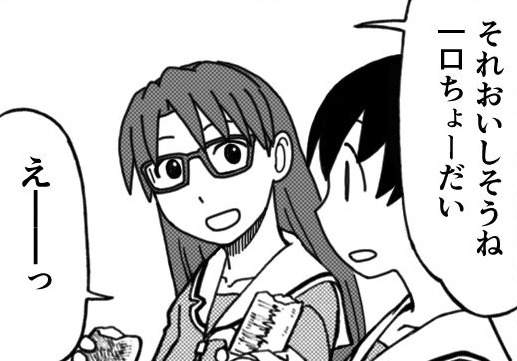
The girls are eating lunch together on the school roof. Tomo is eating a bread roll from a wrapper, and Yomi has her eye on it.
- よみ:
- 「それおいしそうね 一口ちょーだい」
- “That looks good. Give me a bite.”
- とも:
- 「え——っ」
- “Awww!”
Key Points
- ちょうだい after a noun means “give me” that thing. It’s the familiar counterpart of ください: 一口ください would be the polite version.
- Standard Japanese would put を after the noun, as in 一口をちょうだい. Casual speech often drops it, as Yomi does here.
- ちょーだい is the same word. The long-vowel mark ー replaces う, as in casual writing. It makes the request sound drawn out and wheedling.
- 〜そう after an adjective stem says how something looks. おいしい drops its い and becomes おいしそう, “looks delicious”.
- Yomi hasn’t tasted the bread, so she can only judge by appearance. That’s the setup for asking for a bite.
- ね at the end of おいしそうね asks the listener to share the impression: “that looks good, doesn’t it?” It softens Yomi up for the request that follows.
Vocabulary
それ (That)
それ points to something near the listener, or to something just mentioned.
おいしい (Delicious)
おいしい describes food or drink that tastes good. In slang, it also describes a situation that brings an advantage. It is also written 美味しい.
一口 (One bite)
一口 is one bite or one mouthful of food, or one sip of a drink. It’s the usual amount to ask for when you want a taste of someone else’s food.
ちょうだい (Give me; please)
ちょうだい is the kana spelling of 頂戴. After a noun it means “give me”, and after a て-form verb it makes a familiar request, as in 呼んでちょうだい, “call me”. It sounds close and friendly, and women, children, and older people speaking to younger ones use it most.
See Also
- Grammar: Requests with 〜てください and 〜てくれ
- Grammar: Looking like with 〜そうだ
- Grammar: Seeking agreement with ね