At one's limit with 限界
Kanji Explanation: Boundaries and limits with 限
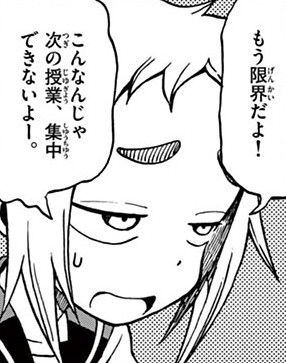
Mina wants to hurry and eat her lunch, as she’s very hungry. Yukari reminders her they still have one more class first.
- ミナ:
- 「もう限界だよ!こんなんじゃ次の授業、集中できないよー。」
- “I'm already at my limit! As things are, come next class I won't be able to concentrate.”
- Literal: “I'm already at my limit! Like this, next class, I won't be able to concentrate.”
Key Points
1限界 = “at my limit”
- In this scene, 限界 means Mina has reached the point where she cannot comfortably keep going as she is.
- It is not an abstract “boundary” here, but her practical limit: she is so hungry that she feels she cannot make it through the next class properly.
2もう限界だよ = an emphatic complaint
- もう adds the feeling of “already” / “I can’t take any more”.
- だよ makes the statement direct and emotionally pushed outward, like Mina is blurting out how bad the situation feels.
3こんなんじゃ is a casual contraction
- こんなんじゃ is a spoken shortening of こんなのでは.
- Here it means “if things are like this” or “as things are now”, referring to her current hungry condition.
4できない = inability to do something
- 集中できない is “be unable to concentrate”, with できない showing inability rather than simple refusal.
Vocabulary
| Word | English | Meaning |
|---|---|---|
| もう | Already | もう means something has already happened, or with a negative, “no longer”. Before a number, it means “more”. Said alone, it shows frustration. |
| 限界 | Limit | 限界 means the limit or boundary beyond which something cannot go. |
| こんなん | Like this | こんなん is a casual, contracted form of こんなの, “something like this”. |
| 次 | Next | 次 is the next one in order. |
| 授業 | Lesson | 授業 is a lesson or class taught at school. |
| 集中 | Concentration | 集中 means focusing attention, effort, people, or resources in one place. |
See Also
- Kanji: Boundaries and limits with 限
- Grammar: Able to do with 〜れる・〜られる
- Grammar: Negation with 〜ない
- Grammar: Informing with よ
- Kanji: Boundaries and worlds with 界
- Kanji: Work and vocation with 業
あしたは土曜日 © its respective creators. It is used here for educational commentary.