Attempts disguised as accidents with 見せかける
Vocabulary Explanation: Words ending in 掛ける
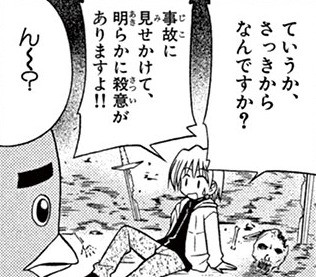
At an amusement park, Nagi is too scared to go into the haunted house, so she sends Hayate in alone to see whether it’s scary. The costumed staff, who rehearsed hard for the attraction, decide he is an easy target. Inside, they attack him with real weapons, and Hayate dodges one close call after another.
- ハヤテ:
- 「ていうか、さっきからなんですか?」
- “More to the point, what is with you guys?”
- 「事故に見せかけて、明らかに殺意がありますよ!!」
- “You're making it look like accidents, but you're obviously trying to kill me!!”
- ニワトリ:
- 「ん〜っ?」
- “Hmm?”
Key Points
- 見せる means to show. 見せかける means to make something appear to be what it isn’t, to fake it.
- に marks what it is made to look like. 事故に見せかける, “make it look like an accident”, is a stock phrase in mystery stories.
- The て-form 見せかけて connects to the next clause. The contrast comes from context: it’s made to look like an accident, but the intent to kill is clear.
- 殺意 means intent to kill. 明らかに means “clearly” or “obviously”.
- Hayate stays polite with あります even while accusing the staff of trying to kill him.
- ていうか is a casual “more to the point” or “actually”. It shifts to what the speaker really wants to say.
- さっきから means “for a while now”. Hayate has noticed a pattern in the attacks.
Vocabulary
さっき (A moment ago)
さっき is a short time before now.
見せかける (To make something look like)
見せかける is to make something appear to be what it isn’t. 〜に見せかける means to disguise something as something else, as in 事故に見せかける, “make it look like an accident”.
明らか (Clear)
明らか means clear or obvious, so that anyone can see it. 明らかに works as an adverb meaning “clearly” or “obviously”.
ある (To exist)
ある is to exist or be in a place, for things and plants rather than people or animals. It also means to have something, or for an event to take place.
See Also
- Vocabulary: Words ending in 掛ける
- Grammar: Connecting actions with 〜て・〜で
- Grammar: Polite style with です and ます
- Kanji: Matters and events with 事
- Kanji: Seeing and viewpoints with 見
- Kanji: Thought and intention with 意